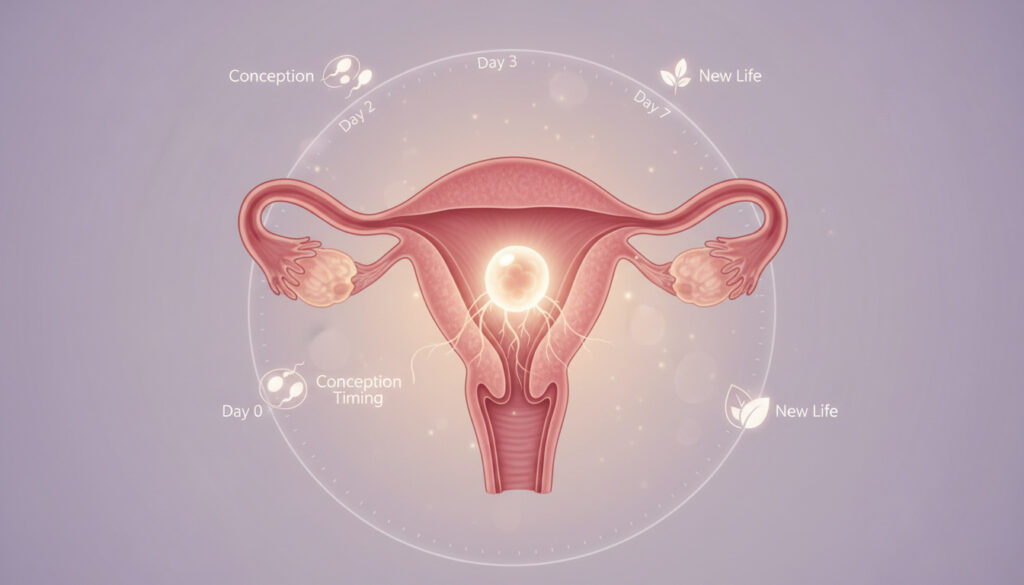
When Does Implantation Occur – Timing Signs and Pregnancy Timeline
Implantation marks the definitive start of pregnancy. This biological process occurs when a fertilized embryo attaches to the uterine lining, triggering the hormonal cascade that sustains gestation.
The timing follows a predictable pattern tied to ovulation. Most successful pregnancies result from embryos implanting during a specific mid-cycle window, though individual variation exists based on embryo quality and uterine receptivity.
Understanding this timeline helps clarify early pregnancy testing accuracy and the significance of subtle physical signs that may—or may not—appear during this critical developmental phase.
When Does Implantation Occur After Ovulation?
6-12 days post-ovulation (DPO)
1-3 days for complete attachment
Light spotting, mild cramps (not universal)
hCG rise detectable 10-14 DPO
- Implantation occurs after the fertilized egg travels from the fallopian tube to the uterus
- The process typically spans 1-3 days of attachment to the endometrium
- 84% of live birth pregnancies implant during days 8-10 DPO
- Early implantation by day 9 correlates with better pregnancy outcomes
- Late implantation after day 10 associates with higher miscarriage risk
- Implantation failure represents a common cause of early pregnancy loss
- Not all successful implantations produce noticeable physical symptoms
| Stage | Days Post-Ovulation | Key Event |
|---|---|---|
| Ovulation | Day 0 | Egg release from ovary |
| Fertilization | 0-1 | Sperm meets egg in fallopian tube |
| Zygote Formation | 1-3 | Cell division begins |
| Transport | 1-5 | Embryo travel to uterus |
| Blastocyst Arrival | 5-6 | Embryo reaches uterine cavity |
| Implantation Window | 6-12 | Attachment to uterine lining |
| hCG Production | 8-14 | Hormone detectable in blood/urine |
| Testing Viability | 14+ | Home pregnancy test accuracy peaks |
What Are the Common Signs of Implantation?
Physical manifestations of implantation vary significantly between individuals. While some women experience distinct symptoms, others remain asymptomatic throughout the process.
Is Implantation Bleeding a Reliable Sign?
Light spotting occurs in some cases when the embryo burrows into the endometrial lining. This bleeding differs from menstrual flow—it typically appears as scant, pink or brown discharge rather than heavy red bleeding.
However, medical observations indicate that implantation bleeding does not occur in all pregnancies. Absence of spotting does not indicate failed implantation, and presence of bleeding requires differentiation from other causes such as cervical irritation or early menstrual flow.
What Physical Sensations Accompany Attachment?
Mild cramping represents another potential indicator, resulting from the embryo’s invasion of the uterine wall. These sensations typically remain subtle and brief, distinct from premenstrual cramping in intensity and duration.
Fatigue and breast tenderness may accompany implantation, though these symptoms overlap significantly with premenstrual syndrome. Definitive confirmation requires hormone testing rather than symptom observation.
How Long After Conception Does Implantation Typically Happen?
Conception—defined as fertilization of the egg by sperm—precedes implantation by several days. The embryo requires time to undergo multiple cell divisions and transport through the fallopian tube before reaching the uterus.
Can Implantation Occur Later Than Day 12?
While the standard window spans 6-12 days post-ovulation, rare cases may see implantation occur outside this range. However, data suggests that implantation after day 12 occurs less frequently and may correlate with reduced viability.
Tracking methods influence perceived timing. Ovulation prediction via basal body temperature, hormone kits, or cycle apps provides the most accurate DPO calculations. Intercourse dates prove less reliable for timing implantation, as sperm can survive several days before fertilization occurs.
Why Does Early Versus Late Implantation Matter?
Implantation timing affects pregnancy outcomes. Embryos implanting by day 9 demonstrate approximately 13% risk of early loss, while later implantation shows increased miscarriage rates. This correlation reflects embryo quality and uterine receptivity factors.
What Happens During the Implantation Process?
Implantation constitutes a multi-stage biological event requiring precise hormonal coordination between the embryo and maternal tissue.
How Does the Embryo Prepare for Attachment?
Following fertilization, the zygote undergoes cleavage divisions while traveling through the fallopian tube. By day 5-6, it becomes a blastocyst—a hollow sphere containing an inner cell mass that will form the fetus and an outer layer called the trophoblast that will become the placenta.
The blastocyst must hatch from its protective zona pellucida before contacting the endometrium. This hatching enables the trophoblast cells to adhere to and invade the uterine lining.
What Role Does Progesterone Play?
The endometrium enters a receptive state called the “implantation window” under progesterone influence. This hormone, produced by the corpus luteum after ovulation, transforms the uterine lining into a nutrient-rich environment capable of supporting embryonic development.
In vitro fertilization protocols precisely time embryo transfer to coincide with the implantation window, typically days 6-10 post-ovulation or fertilization. Uterine receptivity testing helps determine optimal transfer timing for fertility treatments.
When implantation fails, the embryo disintegrates and menstruation occurs normally. This represents the most common form of early pregnancy loss, often before a woman recognizes conception occurred.
What Is the Typical Timeline From Ovulation to Pregnancy Detection?
- — Egg release from ovarian follicle
- — Sperm meets egg in fallopian tube within 24 hours
- — Zygote divides and moves toward uterus
- — Blastocyst enters uterine cavity
- — 84% of viable pregnancies implant during this window
- — Hormone becomes detectable in urine
- — Home pregnancy tests achieve reliable accuracy
What Do We Know for Certain About Implantation Timing?
| Established Facts | Remaining Uncertainties |
|---|---|
| Implantation occurs 6-12 DPO in 95% of cases | Exact day varies by individual embryo quality |
| Day 9 represents the most common implantation day | Specific uterine factor contributions remain unclear |
| Early implantation correlates with lower loss rates | Complete mechanisms of implantation failure unknown |
| Progesterone is essential for uterine receptivity | Why some embryos implant late despite viability |
| hCG production begins immediately after implantation | Precise pain prevalence statistics unavailable |
Why Does Implantation Timing Matter for Early Pregnancy?
The interval between ovulation and implantation determines when pregnancy becomes detectable and influences miscarriage risk profiles. Medical professionals calculate gestational age from the first day of the last menstrual period, making ovulation timing—and subsequent implantation—critical for accurate dating.
Understanding this biological window helps interpret early pregnancy test results. Testing too early, before implantation completes and hCG rises, yields false negatives. For individuals tracking fertility, recognizing that Postural Orthostatic Tachycardia Syndrome Symptoms can sometimes mimic early pregnancy signs underscores the importance of hormonal confirmation rather than symptom reliance.
Age affects implantation success rates, with older maternal age correlating with reduced success, though specific percentage breakdowns require individual medical consultation.
What Do Medical Authorities Say About Implantation?
Fertilization occurs in the fallopian tube, and the embryo reaches the uterus approximately 8-9 days later.
— American College of Obstetricians and Gynecologists (ACOG)
The implantation window represents a brief period when the endometrium is receptive to embryo attachment, governed primarily by progesterone levels.
— Reproductive Endocrinology Research
When Should You Take a Pregnancy Test?
Home pregnancy tests detect human chorionic gonadotropin (hCG), which the placenta produces only after implantation completes. Testing accuracy improves significantly when performed 10-14 days past ovulation, allowing sufficient hormone accumulation in urine. For those monitoring astrological cycles alongside biological ones, checking a Capricorn Horoscope Today offers no predictive value for implantation timing—hormonal tracking and medical consultation provide the only reliable confirmation methods.
Frequently Asked Questions
What happens if implantation fails?
The embryo disintegrates and the endometrial lining sheds during menstruation. This represents the most common form of early pregnancy loss, often occurring before any pregnancy symptoms develop.
How can I confirm implantation occurred?
Blood tests detecting hCG provide definitive confirmation. Home urine tests become accurate 10-14 days after ovulation. Physical signs alone cannot confirm implantation.
Is implantation painful?
Most women experience no pain. Some report mild cramping or twinges, but significant pain is uncommon and may indicate other conditions requiring medical evaluation.
Can stress delay implantation?
Research has not established a direct causal link between stress and implantation timing. The process follows biological timelines primarily determined by embryo development and uterine receptivity.
Does implantation bleeding always occur?
No. Studies indicate most pregnant women do not experience noticeable bleeding during implantation. Absence of bleeding does not indicate pregnancy failure.
Can implantation happen 5 days after ovulation?
While technically possible, implantation before day 6 occurs rarely. The 6-12 day window represents the standard range for successful attachment.
Why does IVF timing matter for implantation?
Fertility specialists synchronize embryo transfer with the implantation window to maximize success. Transferring embryos when the uterus is maximally receptive improves pregnancy rates.
More related posts
 Paul Reubens Dies at 70: Cause of Death, Legacy
 What’s On in Melbourne: Events, Festivals & Things to Do
 Agnes Moorehead Biography: Death, Son and Net Worth
 Kilimanjaro Peak: Name, Height, Difficulty & Safety
 Alfred Hitchcock: Facts, Films, and the Real Man Behind the Myths
 Vera Blue: Biography, Real Name, The Voice, and More
 How to Freeze Berries: Step-by-Step Guide for Smoothies & More
 Client Case Aelftech Com – Documented Results Across Industries