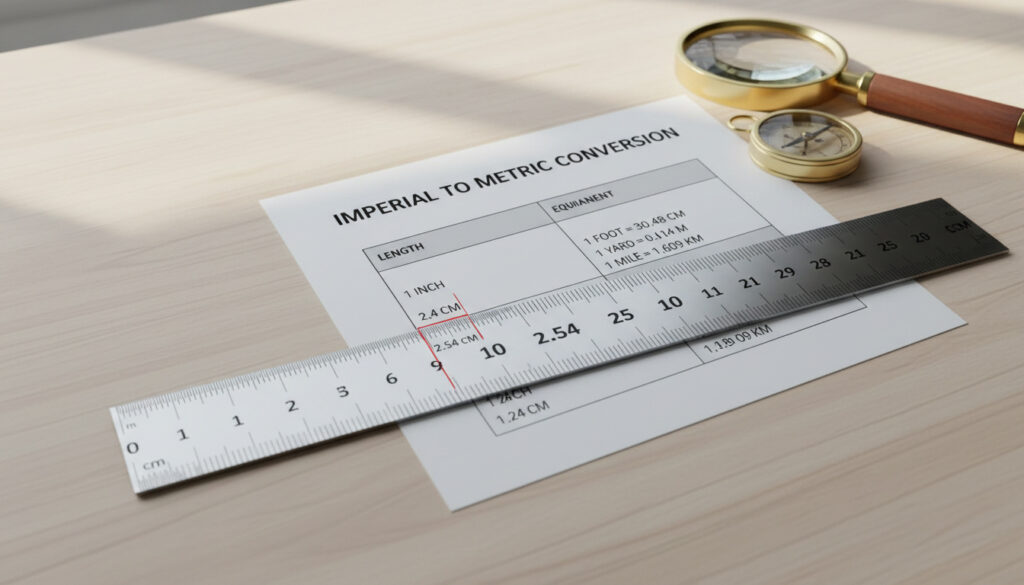
Inches to Centimetres – Exact 2.54 cm Chart and Guide
One inch equals exactly 2.54 centimeters. This precise international standard bridges imperial and metric measurement systems, serving as the definitive ratio for length conversions across engineering, manufacturing, and everyday applications worldwide.
Established in 1959 through the International Yard and Pound Agreement, this definition resolved century-old discrepancies between American and British measurement standards. The exact 2.54 cm value is now legally binding across the United States, United Kingdom, Canada, Australia, and other Commonwealth nations, eliminating rounding errors that previously plagued precision industries.
Understanding this conversion proves essential for global commerce, from determining clothing sizes to calculating screen dimensions and architectural specifications. Unlike approximate conversions, the inch-to-centimeter ratio requires no estimation, providing mathematically exact results every time.
How Many Centimeters Are in an Inch?
1 inch = 2.54 cm precisely
cm = inches × 2.54
Imperial to Metric
International since 1959
- The 2.54 cm value is exact by international definition since 1959, not an approximation
- No rounding is required for precise calculations in engineering or manufacturing
- Commonly used for television screens, clothing sizes, and construction materials
- Adopted by the National Institute of Standards and Technology (NIST) and the International Bureau of Weights and Measures (BIPM)
- Replaced prior variations including the US survey inch which differed slightly
| Inches | Centimeters |
|---|---|
| 1 | 2.54 |
| 2 | 5.08 |
| 5 | 12.7 |
| 10 | 25.4 |
| 12 (1 foot) | 30.48 |
| 20 | 50.8 |
| 30 | 76.2 |
| 40 | 101.6 |
| 50 | 127 |
| 72 | 182.88 |
| 100 | 254 |
How to Convert Inches to Centimeters
Converting inches to centimeters requires only basic multiplication. The process works for any measurement, from fractional increments to large-scale dimensions, maintaining exact precision regardless of the values involved.
The Mathematical Formula
Multiply the inch measurement by 2.54 to obtain the exact centimeter equivalent. For example, a 24-inch monitor calculates as 24 × 2.54 = 60.96 cm. Conversely, to convert centimeters to inches, multiply by 0.3937 (which equals 1/2.54) according to standard mathematical references.
Because 1 inch equals exactly 25.4 millimeters, conversions between inches and centimeters (or millimeters) require no rounding for most practical applications. This exactness stems from the 1959 international agreement that defined the inch as precisely 2.54 cm as documented by Calculator Soup.
Step-by-Step Calculation Method
- Write down the measurement in inches
- Multiply this number by 2.54
- The result is the exact length in centimeters
For manual verification, visual learners may reference educational demonstrations available through instructional videos that illustrate the conversion process using physical rulers and measurement tools.
Inches to CM Conversion Chart
Reference charts provide immediate access to common conversions without calculation. These tables prove particularly useful in retail environments, workshops, and design studios where rapid measurement translation is required.
Comprehensive Reference Table
The following table covers the most frequently requested conversions:
| Inches | Centimeters |
|---|---|
| 1 | 2.54 |
| 3 | 7.62 |
| 4 | 10.16 |
| 6 | 15.24 |
| 8 | 20.32 |
| 12 | 30.48 |
| 24 | 60.96 |
| 36 | 91.44 |
| 48 | 121.92 |
| 60 | 152.4 |
Using Conversion Charts
When consulting charts, verify whether the source uses the international inch definition (2.54 cm exactly) rather than obsolete survey inches. Modern charts developed after 1959 conform to the exact standard, eliminating the minute discrepancies found in historical references.
Common Inches to CM Examples
Screen and Display Measurements
Television and monitor sizes typically use diagonal inch measurements. A 32-inch screen equals 81.28 cm, while a 65-inch display converts to 165.1 cm. These dimensions help consumers understand physical space requirements when arranging home theater systems or workspace setups.
Human height measurements often use the 72-inch mark as a reference point, representing exactly 182.88 cm. This conversion frequently appears in medical records and international travel documents where metric heights are required according to mathematical conversion tables.
Construction and Manufacturing
Standard construction materials often originate in imperial measurements. A 2×4 timber board (actually 1.5 inches by 3.5 inches) converts to 3.81 cm by 8.89 cm. Precise conversion prevents fitting errors when combining imperial-sized materials with metric architectural plans.
Do not round 2.54 cm to 2.5 cm for calculations. While the 0.04 cm difference seems negligible, it compounds significantly over larger measurements. A 100-inch conversion rounded to 250 cm instead of 254 cm creates a 4 cm (1.57 inch) discrepancy, potentially causing expensive errors in precision manufacturing as noted in engineering standards.
History of the Inch Definition
The standardization of the inch-to-centimeter ratio resolved decades of transatlantic measurement confusion. Prior to 1959, subtle differences between American and British inches created complications for international trade.
- : The United States, United Kingdom, Canada, Australia, New Zealand, and South Africa signed the International Yard and Pound Agreement
- : The inch was officially defined as exactly 25.4 millimeters (2.54 centimeters)
- : The National Institute of Standards and Technology (NIST) adopted the exact definition for official US measurements
- : The International Bureau of Weights and Measures (BIPM) recognized the standard, unifying global length measurements
This agreement superseded previous definitions, including the US Survey Inch which varied slightly from the international standard as documented in conversion references.
Is the Conversion Exact or Approximate?
Established Facts
- 1 inch equals exactly 2.54 cm by international treaty
- The definition is legally binding in all Commonwealth countries
- No decimal approximation is needed for precise calculations
- Modern engineering uses this exact ratio exclusively
Historical Variations
- Pre-1959 US survey inch differed slightly (approximately 0.0002 inches)
- 19th century British and American inches varied by country
- Some specialized surveying equipment may still reference obsolete standards
Practical Applications of Inch to Centimeter Conversion
Global commerce depends on precise measurement translation. Marks and Spencer Australia – Where to Shop in 2025 and other international retailers must label clothing dimensions in both inches and centimeters to serve diverse markets. A size 32-inch waist translates to 81.28 cm, ensuring customers understand fit regardless of their native measurement system.
Engineering and manufacturing industries rely on these conversions for component compatibility. Precision tools, automotive parts, and electronic devices often require imperial-metric translation during international assembly. Educational resources demonstrate how machinists use this conversion daily when working with legacy blueprints or modern CAD specifications.
Medical equipment, architectural materials, and consumer electronics all utilize the 2.54 cm standard. Screen sizes, smartphone dimensions, and frame specifications universally reference this exact conversion ratio to maintain consistency across global markets.
Official Standards and Citations
The conversion of 1 inch to 2.54 centimeters represents an exact, defined relationship established by international agreement in 1959, not a measured or approximate value.
The International Bureau of Weights and Measures maintains the International System of Units (SI), which recognizes the inch as exactly 25.4 millimeters through the 1959 Yard and Pound Agreement.
These standards ensure that physical measurements remain consistent across scientific, commercial, and industrial applications worldwide.
Key Takeaways
The conversion between inches and centimeters relies on an exact, legally defined ratio established in 1959: one inch equals precisely 2.54 centimeters. This standard eliminates calculation ambiguity for engineers, manufacturers, and consumers worldwide. Whether measuring physical dimensions or analyzing financial data such as Twitter Share Price – Delisted Status and History, precision matters. For practical application, remember that 5 inches equals 12.7 cm, 12 inches equals 30.48 cm, and 72 inches equals 182.88 cm—each calculated by simple multiplication without rounding or estimation.
Frequently Asked Questions
Is 1 inch exactly 2.54 cm?
Yes. Since 1959, international agreement defines 1 inch as exactly 2.54 centimeters. This is not an approximation but a precise legal standard used worldwide.
How many centimeters is 72 inches?
72 inches equals exactly 182.88 centimeters. This represents 6 feet in imperial measurement, commonly used for human height conversions.
What is the formula to convert inches to cm?
Multiply the inch value by 2.54. For example: inches × 2.54 = centimeters. To reverse the conversion, multiply centimeters by 0.3937.
Why do some sources say 1 inch equals 2.5 cm?
These are rounded approximations. The exact value is 2.54 cm. Rounding to 2.5 creates small errors that accumulate over larger measurements.
Is the inch metric or imperial?
The inch is imperial. Centimeters are metric. The 2.54 cm definition allows precise translation between these two measurement systems.
How do I convert 5 inches to cm?
Multiply 5 by 2.54 to get 12.7 cm exactly. This conversion applies to any measurement in inches.
When did the US adopt the 2.54 cm standard?
The United States adopted the exact 2.54 cm definition in 1959 through the International Yard and Pound Agreement, aligning with British Commonwealth standards.
More related posts
 Jamie Lee O’Donnell: What She’s Doing Now, Partner, and More
 Billy Slater: Biography, Tragedy, Apology & Coaching Career
 How to Open All URLs by Alaikas: Bulk Opener Guide
 Human Resources: Key Roles, Skills & Careers in Ireland
 Bannisters Port Stephens – Location, Dining and Booking Guide
 Murray Watt: Labor Senator and Environment Minister
 Client Case Aelftech Com – Documented Results Across Industries
 SuccessFactors Woolworths Login: Step‑by‑Step Guide