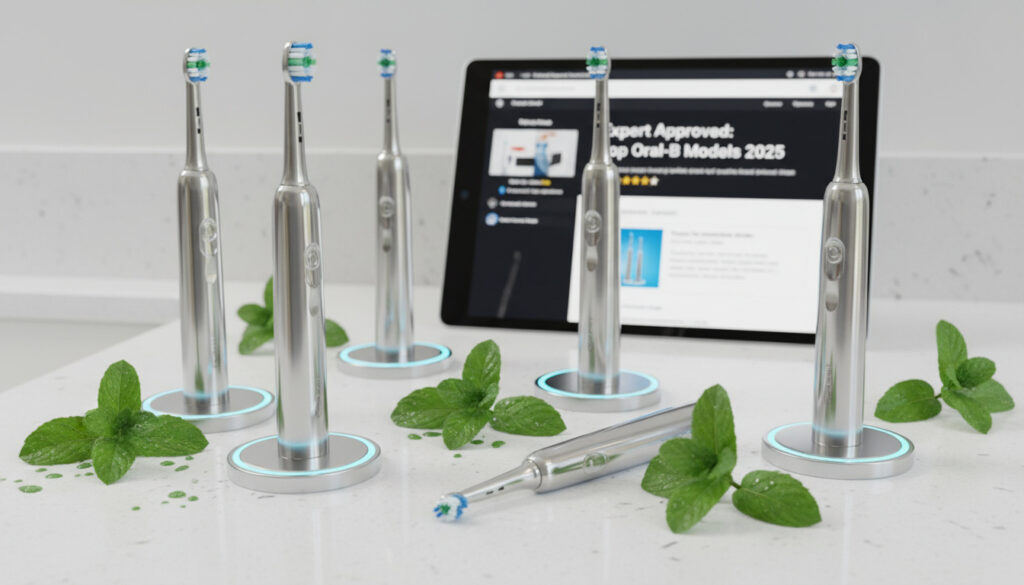
Oral B Electric Toothbrush – Best Models and Reviews 2025
Selecting the right electric toothbrush requires balancing clinical effectiveness with daily usability. Oral-B remains a dominant force in the powered oral care market, distinguished by its oscillating-rotating technology and extensive model range spanning from budget-friendly basics to app-connected smart devices.
This analysis examines the current Oral-B lineup, comparing flagship models like the iO Series against established performers such as the Pro 1000. We evaluate performance claims against independent testing data, assess long-term ownership costs, and determine which features justify premium pricing in 2025.
Whether prioritizing plaque removal efficacy, sensitive gum compatibility, or travel convenience, understanding the technical distinctions between Oral-B’s product tiers enables informed purchasing decisions.
What Is the Best Oral-B Electric Toothbrush?
The optimal Oral-B model depends on specific oral health needs and budget constraints. Current testing indicates distinct performance tiers across the product range.
Independent evaluations highlight specific strengths across these models. Electric Teeth ranks the iO6 as the best overall balance, citing its combination of advanced features and moderate pricing. Conversely, Good Housekeeping designates the Pro 1000 as best overall for its intuitive interface and pressure sensor at a low cost point.
- Oscillating-rotating technology removes up to 48% more plaque at the gumline than manual brushing, per manufacturer-funded clinical studies
- iO Series micro-vibrations operate at 64-72dB, significantly quieter than traditional Oral-B models at 73dB
- Pro 1000 delivers essential features—pressure sensor, quadrant timer, daily clean mode—under $50
- Replacement heads average $5-10 each, with BrushSync technology tracking usage on premium models
- Battery life spans 10-14 days for standard models, with iO Series offering consistent 14-day performance
- Bluetooth connectivity and position tracking remain limited to iO9 and Genius X variants
- Sensitive teeth compatibility varies: iO Series offers dedicated sensitive modes absent in Pro 1000
| Model | Battery Life | Cleaning Modes | Pressure Sensor | Approx. Price | Head Cost (Annual) |
|---|---|---|---|---|---|
| Pro 1000 | 10-14 days | 1 (Daily Clean) | Visual only | $50 | $20-40 |
| iO Series 3 | 14 days | 2-3 | Visual + haptic | $70 | $20-40 |
| iO Series 6 | 14 days | 5 | Smart pressure | $115 | $20-40 |
| iO Series 9 | 14 days | 7 | 3D tracking | $200+ | $20-40 |
| Genius X | 14 days | 6 | Position detection | $150 | $20-40 |
| Smart 1500 | 14 days | 3 | Basic visual | $60 | $20-40 |
Oral-B vs Philips Sonicare: Which Is Better?
The rivalry between these manufacturers centers on fundamentally different mechanical approaches to plaque removal. Oral-B’s oscillating-rotating-pulsating action creates a physical scrubbing motion, while Sonicare employs high-frequency sonic vibrations for a gentler sweeping effect.
Cleaning Technology and Efficacy
Oral-B’s round brush heads rotate and pulsate to break up plaque mechanically. Clinical research funded by Oral-B indicates the iO Series achieves superior plaque removal compared to Sonicare’s DiamondClean Smart, particularly at the gumline. However, hands-on testing reveals Sonicare’s sonic action feels less aggressive, potentially benefiting users with sensitive gums or recession.
Noise Levels and Sensory Experience
Acoustic measurements show significant variance between brands. Sonicare models operate between 57-60dB, creating a humming sensation. Oral-B’s traditional models reach 73dB, though the iO Series reduces this to 64-72dB through magnetic drive technology. Users describe the Sonicare experience as “gentler” and Oral-B as providing a “dentist-clean” feel.
Battery Performance and Portability
Sonicare leads in battery longevity, with the 4100 model delivering 17-20 days per charge and the 9900 Prestige extending to 28 days. Oral-B models consistently provide 10-14 days, requiring more frequent charging during travel. However, Oral-B’s charging bases prove more compact than Sonicare’s premium glass chargers.
Sonicare devices provide obvious vibration feedback when excessive pressure is applied, while Oral-B indicators remain subtle visual cues. Users must consciously check the handle light during brushing to avoid over-pressing with Oral-B models.
Are Oral-B Electric Toothbrushes Worth It?
Value assessment requires analyzing both acquisition costs and long-term maintenance expenses. Community feedback suggests satisfaction correlates strongly with matching features to actual usage patterns rather than purchasing maximum specifications.
Entry-Level Economics
The Pro 1000 and iO3 deliver essential electric brushing benefits—timers, pressure sensors, and superior plaque removal—at price points under $70. For users transitioning from manual brushing, these models eliminate the primary risk of over-brushing while providing measurable clinical benefits. Postural Orthostatic Tachycardia Syndrome Symptoms – Key Insights may affect manual dexterity, making electric options particularly valuable for consistent cleaning motion.
Premium Feature Justification
Mid-range models like the iO6 ($115) add quality-of-life improvements: quieter operation, multiple intensity modes, and BrushSync head recognition. The iO9’s color screen and position tracking appeal to data-driven users but may exceed needs for those seeking basic oral hygiene maintenance. Savings diminish when users purchase advanced features they rarely access.
Total Cost of Ownership
Annual operating costs include replacement heads ($20-40) and electricity for charging. Oral-B heads typically cost less than Sonicare equivalents, though both require quarterly replacement. Over a five-year period, the Pro 1000 represents the most economical path to powered brushing, while iO Series ownership costs reflect premium positioning.
How Long Do Oral-B Electric Toothbrush Heads and Batteries Last?
Component longevity directly impacts maintenance schedules and hygiene effectiveness. Understanding replacement intervals prevents bacterial buildup and motor degradation.
Brush Head Lifespan
Oral-B recommends replacing brush heads every three months, matching ADA guidelines for bristle integrity. BrushSync-enabled models (iO Series, Genius) track usage duration and bristle wear via RFID chips, displaying replacement alerts on the handle. Video demonstrations confirm proper removal requires firm pulling motion to detach heads from the metal shaft.
Battery Performance Metrics
Lithium-ion batteries in current Oral-B models maintain consistent performance for 10-14 days between charges during normal use (twice daily, two minutes). Full charging requires approximately 24 hours on standard bases. Battery degradation becomes noticeable after 2-3 years, manifesting as reduced operating time between charges.
Maintenance Protocols
Daily rinsing of brush heads prevents toothpaste residue buildup. Storage in upright position allows water drainage from the metal connector, reducing corrosion risk. Unlike Sonicare, Pro 1000 models lack automatic power-off at cycle completion, requiring manual shutoff to conserve battery.
iO Series and Genius models utilize RFID chips embedded in brush heads to track usage duration. The handle displays visual alerts when bristles approach end-of-life, typically after 180 uses.
Avoid storing charging bases in humid bathroom environments to prevent electrical contact corrosion. Ensure brush handles dry completely before docking to maintain charging efficiency and prevent base unit damage.
The Evolution of Oral-B’s Electric Lineup
Understanding product development clarifies current technological capabilities and upgrade rationale.
- : Pro 1000 introduction establishes oscillating-rotating standard with 3D cleaning action (rotation, pulsation, oscillation)
- : Genius X launch incorporates AI position detection and Bluetooth connectivity for brushing habit analysis
- : iO Series debut featuring magnetic drive system, micro-vibrations, and linear magnetic motor replacing mechanical drives
- : iO3 and iO6 variants expand mid-range options, democratizing quiet-drive technology previously limited to flagship models
- : Current optimization focuses on battery efficiency algorithms and refined pressure sensing across all tiers
Established Facts and Remaining Uncertainties
| Established Information | Uncertain or Variable Factors |
|---|---|
| Oscillating-rotating technology demonstrates superior plaque removal versus manual brushing in clinical settings | Long-term battery degradation rates beyond 24 months of daily use |
| ADA Seal of Acceptance confirms safety and efficacy for multiple Oral-B models | Real-world plaque removal variance between iO magnetic drive and traditional oscillating models in independent studies |
| Pressure sensors reduce incidence of gingival abrasion and enamel wear | Individual sensitivity thresholds determining optimal brush head stiffness |
| Quarterly brush head replacement maintains optimal bristle geometry for cleaning | Exact cost comparisons with competing brands when accounting for promotional pricing fluctuations |
Understanding Oscillating-Rotating Technology
Oral-B’s distinctive small, round brush heads rotate clockwise and counterclockwise while pulsating vertically against tooth surfaces. This mechanical action physically breaks plaque bonds rather than relying primarily on fluid dynamics. The approach proves particularly effective for interdental cleaning and posterior tooth surfaces where access proves challenging.
The iO Series refines this mechanism through magnetic suspension, eliminating mechanical friction for quieter operation while maintaining oscillation frequencies. Marks and Spencer Australia – Where to Shop in 2025 offers retail availability context for Australian consumers seeking these devices.
Users with orthodontic appliances or dental bridges benefit from the targeted cleaning action, though those with severe gum recession may find sonic alternatives less abrasive during flare-ups.
Expert Evaluations and Testing Data
The Oral-B Pro 1000 offers the best combination of features and cleaning power for the price, with an intuitive interface that doesn’t overwhelm new electric toothbrush users.
Good Housekeeping Institute Health & Beauty Lab
The iO Series 6 hits the sweet spot for most users—quieter than traditional Oral-B models, effective plaque removal, and enough features to justify the price without the luxury tax of the iO9.
Electric Teeth Review
Pressure sensors prove essential regardless of brand choice. Users consistently over-brush with manual pressure habits; the visual feedback, while subtle on Oral-B, prevents tissue damage once users adapt to checking the indicator.
Clark Community Consumer Reports
Final Selection Guidance
Choose the Pro 1000 for fundamental electric brushing benefits without financial strain, the iO6 for advanced features balanced against cost, or the iO9 only if app integration and display feedback justify the premium. Prioritize pressure sensor inclusion regardless of model tier, and confirm brush head availability before purchasing discontinued variants.
Common Questions
How do I use an Oral-B electric toothbrush correctly?
Place the brush head at a 45-degree angle to the gumline. Let the brush do the work—guide it slowly across surfaces without scrubbing. Spend 30 seconds per quadrant for the full two-minute cycle. Check the pressure sensor light to ensure you’re not pressing too hard.
Why is my Oral-B electric toothbrush not charging?
First ensure the charging base connects to a working outlet. Clean the metal contacts on both the brush base and charger with a dry cloth to remove corrosion or debris. Allow the handle to dry completely before docking. If problems persist after 24 hours on the charger, battery degradation may require replacement.
How much do replacement heads cost annually?
At approximately $5-10 per head and replacement every three months, expect $20-40 yearly costs. Bulk purchasing reduces per-unit pricing. BrushSync-enabled models track usage and alert you at optimal replacement intervals, preventing premature changes.
Can I use Oral-B electric toothbrushes with braces?
Yes. The oscillating-rotating action effectively cleans around brackets and wires. Use orthodontic-specific brush heads or standard precision heads angled carefully around hardware. The pressure sensor helps prevent damage to orthodontic cement during cleaning.
What’s the difference between iO and standard Oral-B models?
iO Series uses magnetic linear motors for micro-vibrations and quieter operation (64-72dB), while standard models use mechanical drives (73dB). iO handles feature interactive displays and BrushSync RFID tracking. Standard Pro series offers basic oscillating-rotating cleaning without smart features.
How do I clean and maintain my Oral-B toothbrush?
Rinse the brush head thoroughly after each use and shake off excess water. Wipe the handle monthly with a damp cloth—never submerge it. Store upright in a dry environment. Remove the brush head periodically to clean the metal shaft and prevent buildup.
Which Oral-B model is best for sensitive teeth?
The iO Series offers dedicated Sensitive modes with reduced intensity. Avoid the Pro 1000, which lacks sensitivity settings and delivers full oscillating force. Alternatively, consider Sonicare for gentler sonic action if Oral-B’s mechanical cleaning proves too intense.
Does the Oral-B Pro 1000 have a timer?
Yes. The Pro 1000 includes a quadrant timer that pulses every 30 seconds to signal moving to the next section of your mouth, and a two-minute auto-shutoff on some variants. However, it lacks the automatic power-off at cycle completion found in Sonicare models.
More related posts
 Talk to Me Movie: Scary? True Story? Age Rating Guide
 Tessa Thompson: Biography, Movies, Relationships, and Sexuality
 Melbourne Cup 2025 – Winner Results and Key Facts
 Kilimanjaro Peak: Name, Height, Difficulty & Safety
 Preslee Faith: Age, Bio, Religion, and TikTok Fame
 Brian To’o: NRL Career, Salary, and Family Life
 Alexandra Grant: Art, Age, and Relationship with Keanu
 Pat Cummins: Net Worth, Career, Personal Life & Future Plans