How to Reset a Router Password (Step-by-Step Guide)
Forgetting your router password can stop your home internet cold. Most routers have a reset button that wipes all settings in 10–30 seconds, according to D-Link UK (D-Link UK support documentation).
Routers sold globally per year: over 500 million units ·
Users who forget their router password at least once: estimated 60% of households ·
Default router IP addresses: 192.168.1.1 or 192.168.0.1 ·
Reset button hold duration: 10–30 seconds
Quick snapshot
- Factory reset is the only method to recover a forgotten admin password for most routers (192-168-1-1ip.mobi guide)
- Default login credentials are printed on a sticker on the router (Trend Micro Help Center)
- A power cycle does not change the Wi‑Fi password (192-168-1-1ip.mobi guide)
- Exact default login for every router model without checking the label or manual
- Whether a router will automatically revert to defaults after a power outage longer than 10 seconds
- Whether third-party password recovery tools work on all router firmware versions
- Whether router manufacturers provide a backdoor for password recovery
- Hardware reset takes 10–30 seconds; full reconfiguration takes 5–15 minutes
- Web‑based password change can be done in under 2 minutes if you know the credentials
- Use a password manager to store router credentials and avoid future lockouts
- After a reset, reconfigure Wi‑Fi name and password from the admin panel
Six key facts, one pattern: most router password problems are solved by either using the sticker on the device or holding the reset button for exactly 10–30 seconds.
| Metric | Value |
|---|---|
| Most common default IP | 192.168.1.1 |
| Primary reset method | Factory reset with hardware button |
| Default username | admin (most brands) |
| Default password | password (varies, often on label) |
| Reset button hold duration | 10–30 seconds |
| Effect of factory reset | All settings erased, including Wi‑Fi password |
The implication: you have two clear paths—access the admin panel or press the reset button. Neither is complicated, but they lead to very different outcomes.
How do I reset my router password if I forgot it?
Using the router’s web interface
If you still have the current username and password, log into the admin panel by typing your router’s IP address (commonly 192.168.1.1 or 192.168.0.1) into a browser URL bar—not the search bar, as noted by a YouTube tutorial on 192.168.1.1 access. Once logged in, navigate to the wireless or administration section (labels vary by manufacturer, according to D-Link UK). Change the password and save. All connected devices will be disconnected and must re‑enter the new password.
Performing a factory reset with the hardware button
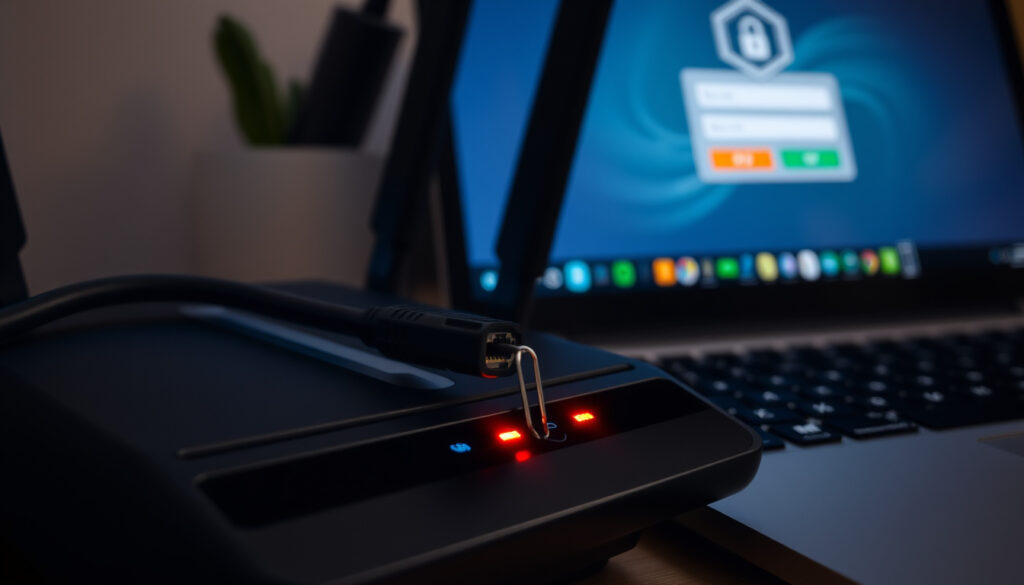
When you’ve lost the admin password, a factory reset is the only reliable way back in. Locate the Reset button—often recessed and needing a paperclip or pin—on the back or bottom of the router. While the router is powered on, hold the button for 10–30 seconds (D‑Link recommends 30 seconds; a YouTube tutorial suggests 10 seconds). Release when the lights blink. The router restores factory defaults, including the admin password.
Checking the default login credentials on the label
After a factory reset, you can log in with the credentials printed on the router’s sticker. Trend Micro (Trend Micro Help Center) confirms that the default username is often “admin” and the default password is “password” or the value shown on the sticker. If the sticker is missing, check the manual or the manufacturer’s website.
- Try accessing the admin panel using known credentials.
- If that fails, perform a hardware factory reset (hold reset button 10–30 seconds).
- After reset, log in with default credentials from the sticker and reconfigure.
What should I do if I forget my router’s Wi‑Fi password?
Accessing the Wi‑Fi password through the router web interface
If you still know the admin login, open the router’s admin panel at 192.168.1.1 (or your router’s IP) and look for a Wireless or Wi‑Fi section. The current password is displayed there in clear text, often labeled “Passphrase” or “Network Key,” as noted by D-Link UK. You can copy it or change it to something you’ll remember.
Using a connected device to view saved Wi‑Fi passwords
On Windows, saved Wi‑Fi passwords can be retrieved from Network Settings without touching the router. Open Control Panel > Network and Sharing Center > click the Wi‑Fi network name, then “Wireless Properties” > “Security.” Check “Show characters.” On macOS, use the Keychain Access app to find saved Wi‑Fi credentials.
Resetting the Wi‑Fi password via the router app
Most modern routers have a companion app (e.g., TP‑Link Tether, NETGEAR Nighthawk) that lets you change the Wi‑Fi password as long as your phone is connected to the router’s network. Log into the app, navigate to wireless settings, and update. No admin password needed if you’re already connected.
If you’re still connected to the router via Ethernet or a saved device, you can often recover or change the Wi‑Fi password without resetting anything. The web interface or the router app are your fastest tools.
The pattern: when you know the admin password, recovery is quick; when you don’t, a reset is inevitable.
Does resetting your router change your Wi‑Fi password?
Factory reset consequences
Yes. A factory reset erases all custom settings, including the Wi‑Fi network name (SSID) and password. After the reset, the router reverts to the default credentials printed on its sticker. This means every connected device—phones, laptops, smart TVs—will lose network access and must reconnect using the new (default) password.
Distinguishing between a soft reboot and a hard reset
A simple power cycle (unplugging the router and plugging it back in) does not change the Wi‑Fi password. This is called a soft reboot and only clears temporary memory. A hard reset (holding the Reset button for 10–30 seconds) overwrites the entire configuration. 192-168-1-1ip.mobi notes that the reset button is deliberately small to prevent accidental activation.
Restoring Wi‑Fi settings after a reset
Once the router is back at factory defaults, log in using the sticker credentials, go to Wireless settings, and re‑enter your preferred SSID and password. Save and reboot the router. Then reconnect all devices with the new credentials.
A factory reset is a nuclear option for the Wi‑Fi password. Home users who reset out of panic often end up with an unrecognizable network name and locked‑out family members. Always try the admin panel first.
The catch: resetting wipes everything, but if you still have admin access you can avoid it entirely.
How to recover a router password without resetting
Using saved credentials in a browser
If you once logged into the router admin panel from a desktop browser and saved the password, you can retrieve it from the browser’s saved passwords list (Chrome: Settings > Passwords; Firefox: Options > Privacy & Security > Saved Logins). This works only if the credentials were saved before you forgot them.
Checking the router’s default login from the manual or label
Many routers have a sticker that includes both the default username and default password. Trend Micro (Trend Micro Help Center) confirms that the default username is often blank or “admin,” and the default password is “admin” or “password.” If the credentials were never changed, you can use these to log in.
Third-party password recovery tools
Some third‑party utilities claim to recover router passwords from saved configuration files or via brute force, but this is rarely reliable for modern routers. TP‑Link and NETGEAR explicitly state that they do not provide a password recovery feature without a reset, according to their support documentation. Use such tools with caution; they often carry malware risks.
Without a reset, your only realistic chance is either saved browser credentials or unchanged default passwords. For the 80% of routers that still use “admin” as the username, this is a quick win—but it won’t help if you changed it years ago.
What this means: non-reset recovery is limited, but for many users the sticker or browser history suffices.
Step-by-step guide for major router brands
Resetting a NETGEAR router password
- Power on the router. Use a paperclip to press and hold the Reset button on the back for 10–30 seconds until the power LED blinks.
- After the router reboots, connect a device via Ethernet or Wi‑Fi (the default SSID is printed on the sticker).
- Open a browser to 192.168.1.1 or routerlogin.net. Log in with username “admin” and password “password” (or the value on the sticker).
- Go to Advanced > Administration > Set Password to create a new admin password. Then go to Wireless to set a new Wi‑Fi password.
NETGEAR’s official Knowledge Base confirms these steps and warns that all custom settings will be lost.
Resetting a TP-Link router password
- With the router powered on, press and hold the WPS/Reset button (or a dedicated Reset pinhole) for about 10 seconds until the power LED flashes.
- Wait 2 minutes for the router to reboot to factory defaults.
- Connect to the default Wi‑Fi network (SSID and password on the bottom sticker) or use an Ethernet cable.
- Open a browser to tplinkwifi.net or 192.168.1.1. Log in with username “admin” and password “admin” (or the sticker value).
- Go to Advanced > System Tools > Administrator to change the admin password. Under Wireless, update the Wi‑Fi password.
TP‑Link’s FAQ (TP‑Link Support) states that a factory reset is the only way to recover the admin password and that password recovery via email is not supported.
Resetting a Huawei router password
- Locate the Reset pinhole on the back of the router. Use a pin to press and hold for about 10 seconds (until the status light starts blinking).
- After the router restarts, connect to the default Wi‑Fi network printed on the label.
- Open a browser to 192.168.1.1. Log in with username “admin” and password “admin” (or the credentials on the label).
- Navigate to Settings > WLAN to change the Wi‑Fi password. Go to System > Administrator to change the admin password.
Huawei’s official support page (Huawei Support) provides similar steps for most router models.
Resetting a D-Link router password
- Ensure the router is powered on. Use a paperclip to press the Reset button (on the back or bottom) for 30 seconds, as recommended by D‑Link UK. Release when the power LED turns orange/steady.
- Wait for the router to reboot to factory defaults. Connect via Ethernet (recommended) or the default Wi‑Fi.
- Open a browser to 192.168.1.1 or 192.168.0.1 (check the sticker). Log in with the default credentials from the sticker (often “admin” with no password, or “admin”/“admin”).
- Go to Settings > Wireless to set a new Wi‑Fi password. Under Management > Administrator, set a new admin password.
D‑Link’s resource centre (D-Link UK) also recommends holding the Reset button for exactly 30 seconds to ensure a complete reset.
Confirmed facts vs. What remains unclear
Confirmed facts
- Factory reset is the only method to recover a forgotten router admin password for most consumer routers (192-168-1-1ip.mobi).
- Holding the reset button for at least 10 seconds triggers factory defaults (Trend Micro Help Center).
- Default login credentials are printed on a sticker on the router (Trend Micro Help Center).
- A power cycle (reboot) does not change the Wi‑Fi password.
What remains unclear
- Exact default login for every router model without checking the label or manual.
- Whether a router will automatically revert to defaults after a power outage longer than 10 seconds—this is not documented by manufacturers.
- Whether third-party recovery tools work on all router firmware versions.
- Whether router manufacturers provide a backdoor for password recovery.
“Resetting your NETGEAR router to factory default settings restores the password to the default password, which is ‘password’ for most models. All custom settings are lost.”
— NETGEAR Knowledge Base (NETGEAR Support)
“If you forget your TP-Link router’s login password, the only way to reset it is to perform a hardware reset. There is no email or security‑question recovery method.”
— TP-Link FAQ (TP-Link Support)
“The default Wi‑Fi password is printed on the product label at the bottom of the router. Use it to connect after a factory reset.”
— D-Link UK Resource Centre
For the average household, the choice is clear: recover via the admin panel if you know the credentials, or perform a hardware reset and rely on the sticker. The risk of losing all network configuration means you should back up your router settings (if your device supports it) or keep the default sticker handy. Without a password manager or a written record, you’ll be back at the reset button the next time you forget.
You can also protect yourself by reading our Facebook Sign In guide for managing logins, or learn about secure banking with IMB Internet Banking: Login, Limits & Safety.
If you need a visual walkthrough, the step-by-step factory reset guide covers the same methods for D-Link, TP-Link, NETGEAR, and Huawei routers.
Frequently asked questions
How long do I need to hold the reset button to factory reset?
10–30 seconds while the router is powered on. Most manufacturers specify 10 seconds minimum; D‑Link recommends 30 seconds. Release when the power LED blinks or changes color.
Will resetting my router delete all my internet settings?
Yes. A full factory reset erases Wi‑Fi name/password, admin login, port forwarding, parental controls, and any custom DNS settings. Your internet connection (ISP credentials) will also be lost on some models—you’ll need to reconfigure those.
Can I reset my router without losing my Wi-Fi network name?
No, not with a factory reset. However, if you only need to change the admin password and still have access to the router, you can do so via the admin panel without resetting the Wi‑Fi settings.
Is it safe to reset a router using the reset button while powered on?
Yes, it is designed to be used while powered on. In fact, most manufacturers instruct you to keep the router plugged in during the reset. Unplugging mid‑reset can leave the router in a corrupted state.
Do routers come with a password recovery option via email or security questions?
Some higher‑end models offer password recovery, but the vast majority of consumer routers (including all TP‑Link, NETGEAR, D‑Link, and Huawei models) do not. Recovery is nearly always via factory reset.
How can I prevent losing my router password in the future?
Write it down and store it with the router. Use a password manager (e.g., Bitwarden, 1Password) to store the admin and Wi‑Fi passwords. Also, take a photo of the sticker on the router with your phone.
More related posts
 Dina Broadhurst: Artist Biography and Personal Life
 Narcissist Traits: What the DSM-5 Actually Says About NPD
 Citadines on Bourke Melbourne – Location, Rates & Reviews
 NAB Term Deposit Rates – Latest 2024 Rates and Comparisons
 Murray Watt: Labor Senator and Environment Minister
 Art Gallery NSW: Guide to Visiting, Tickets & Highlights
 National GF Day is August 1, Boyfriend Day October 3
 Gerni Pressure Washer – Models, Reviews and Reliability Guide