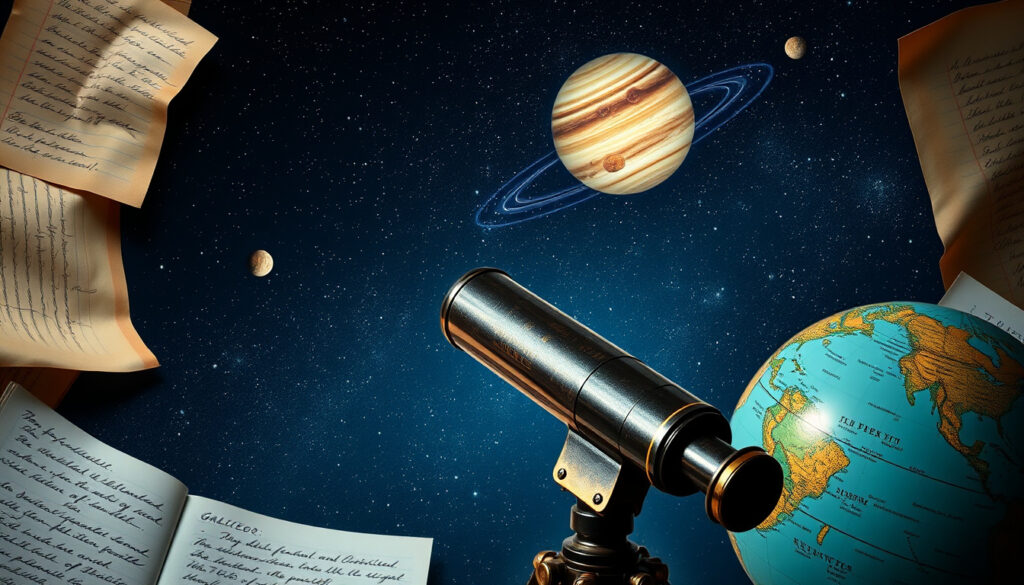
Galileo Galilei: Discoveries, Biography, and Legacy Explained
We tend to picture the universe as a machine that runs on rules we can test—and Galileo Galilei was the first person to show that this was true, not by guessing, but by pointing a homemade telescope at the sky and writing down exactly what he saw. In 1610 alone, his observations of Jupiter’s moons and Venus’s phases challenged a cosmology that had stood for nearly 2,000 years (Britannica biography).
Born: February 15, 1564, Pisa, Italy ·
Died: January 8, 1642, Arcetri, Italy ·
Known for: Astronomy, physics, telescope improvements, heliocentrism ·
Key discovery: Jupiter’s moons, Venus phases, lunar craters
Quick snapshot
- Galileo discovered the four largest moons of Jupiter (Britannica) (Royal Museums Greenwich)
- He improved the telescope and turned it skyward in 1609 (Royal Museums Greenwich)
- He was tried by the Inquisition for heliocentrism in 1633 (Vatican Observatory)
- Whether Galileo actually dropped objects from the Leaning Tower of Pisa—no contemporary source confirms it (UCAR High Altitude Observatory)
- The exact number of telescopes he built remains unknown (NIH / PMC)
- 1610: Publication of Sidereus Nuncius—telescopic discoveries revealed (UCAR High Altitude Observatory)
- 1633: Inquisition trial and forced recantation (Vatican Observatory)
- Vatican formally rehabilitated Galileo in 1992—after 350 years (The New York Times)
- His preserved middle finger remains on display in Florence’s Museo Galileo (The New York Times)
Six key facts, one pattern: Galileo’s career transformed a hobby instrument into a device that rewrote humanity’s place in the cosmos.
| Label | Value |
|---|---|
| Full Name | Galileo di Vincenzo Bonaiuti de’ Galilei |
| Born | 15 February 1564, Pisa, Italy |
| Died | 8 January 1642, Arcetri, Italy |
| Field | Astronomy, physics, mathematics |
| Key Inventions | Improved telescope, thermoscope, military compass |
| Trial | 1633, Inquisition |
What is Galileo most famous for?
Galileo’s fame rests on a single choice: turning a Dutch novelty—the telescope—toward the heavens and recording what he saw. Before him, astronomers relied on naked-eye observations and inherited authority. After him, the sky became a laboratory.
Galileo is most famous for improving the telescope and using it to make systematic astronomical observations that provided the first direct evidence for heliocentrism—the idea that Earth orbits the Sun, not the other way around (Royal Museums Greenwich). He did not invent the telescope, but he was the first to use it methodically to observe celestial objects and record what he found (CSIRO Australia Telescope National Facility).
What is Galileo’s most famous work?
His landmark 1610 book Sidereus Nuncius (Starry Messenger) published his telescopic discoveries and shook Ptolemaic and Aristotelian cosmology to its foundations (UCAR High Altitude Observatory). In 1632, he published Dialogue Concerning the Two Chief World Systems, which directly compared the Copernican and Ptolemaic models and led to his trial.
What was Galileo’s greatest invention?
- His improved telescope: Galileo’s first telescope magnified about four times, but by 1610 he had crafted instruments capable of 20–30× magnification (NIH / PMC).
- He also invented an early type of thermometer (Britannica) and a military compass for surveying and gunnery.
The implication: Galileo’s greatest innovation was not a single device but a method—using empirical observation to test inherited claims. That method, more than any lens, defined modern science.
What did Galileo discover?
For a three-year stretch starting in 1609, Galileo pointed his telescope at everything in the sky and found things no human had seen before.
What three things did Galileo discover?
Each discovery ate away at a different plank of the old cosmos: the Moon’s surface disproved celestial perfection; Jupiter’s moons proved Earth wasn’t the only center of motion; Venus’s phases confirmed planetary orbits around the Sun.
- Four largest moons of Jupiter (Io, Europa, Ganymede, Callisto) — observed in January 1610 (Britannica)
- Phases of Venus — showed that Venus orbits the Sun, not Earth
- Craters and mountains on the Moon — he noted that walls of deep lunar craters cast shadows, proving an uneven surface (University of Chicago eCUIP)
What are 5 things Galileo discovered?
- Jupiter’s four largest moons (1610)
- Phases of Venus (1610)
- Lunar craters and mountains (1609–1610)
- Sunspots and their movement across the Sun’s surface
- The rings of Saturn (he misinterpreted them as “handles” or companion bodies)
What were Galileo’s best discoveries?
Most historians rank the discovery of Jupiter’s moons and the phases of Venus as his most consequential finds because they directly contradicted the Earth-centered model (Royal Museums Greenwich). His lunar observations were also revolutionary: before Galileo, the Moon was assumed to be a perfectly smooth, flawless sphere. He recorded it as mountainous and cratered, contradicting the idea of perfect celestial spheres (University of Chicago eCUIP).
What this means: Galileo’s discoveries didn’t just add facts—they dismantled an entire worldview. Each observation was a brick removed from the Aristotelian-Ptolemaic edifice, and the structure eventually collapsed.
Was Galileo the father of astronomy?
Calling Galileo the “father of astronomy” oversimplifies a longer history—Ptolemy, Copernicus, and Brahe all came before him. But labeling him the “father of modern science” captures what he actually changed: the method, not just the data.
Galileo is often called the father of modern astronomy because of his systematic telescopic observations (Britannica). He pioneered the use of the telescope for celestial study, moving astronomy from a mathematical exercise to an empirical science. His work laid the groundwork for the modern scientific method by emphasizing observation, measurement, and reproducibility.
Why is Galileo considered the father of modern science?
Galileo’s telescopic observations helped establish that celestial bodies could be studied empirically rather than only through inherited philosophical authority (UCAR High Altitude Observatory). He insisted on testing theories against direct observation—a principle that became the bedrock of the Scientific Revolution.
What did Galileo contribute to astronomy?
- He transformed the telescope from a novelty into a scientific instrument
- He provided observational proof for the Copernican system
- He published findings in a vernacular language (Italian), making astronomy accessible
- His work directly influenced Isaac Newton’s theory of universal gravitation
The pattern: Galileo didn’t just discover things—he changed how discovery itself works. That shift, from reading authorities to reading nature, is why his name outlasts almost every other figure of the Scientific Revolution.
Why did they remove Galileo’s finger?
One of the strangest chapters in Galileo’s story has nothing to do with science and everything to do with reverence.
Where is Galileo’s finger now?
After Galileo’s death in 1642, admirers removed three fingers, a tooth, and a vertebra as relics (Britannica). The middle finger is preserved in Florence’s Museo Galileo. The finger was taken by Anton Francesco Gori during Galileo’s exhumation in 1737—nearly a century after his death.
What other body parts were removed from Galileo?
Three fingers total (the thumb, middle, and index finger of the right hand), a tooth, and a vertebra. The relics were traded and lost for centuries before being identified in the early 20th century. The vertebra currently resides at the University of Padua, where Galileo once taught.
The implication: The relic-taking shows that even his contemporaries understood they had lived through something historic. When the Church forced Galileo to recant, his supporters preserved his body as if he were a saint—because in their eyes, he had seen the divine more clearly.
What are 5 facts about Galileo?
“And yet it moves.” — attributed to Galileo after his forced recantation, though many historians doubt he actually said it.
— Attributed to Galileo Galilei, 1633
When and where was Galileo born?
Galileo was born on 15 February 1564 in Pisa, Italy (Vatican Observatory). He was the eldest son of a famous traveling lute player, Vincenzo Galilei.
What was Galileo’s education?
He initially studied medicine at the University of Pisa (enrolling in 1581) but switched to mathematics after discovering a passion for geometry. He left without a degree in 1585 and began private tutoring.
What happened at Galileo’s trial?
In 1633, the Roman Catholic Inquisition tried Galileo for vehement suspicion of heresy. His crime: defending Copernican heliocentrism after being ordered to stop. He was forced to publicly recant his views and was sentenced to house arrest for the rest of his life (Vatican Observatory).
John Milton visited Galileo in prison during his 1638–1639 Italian tour and later referenced the astronomer in Paradise Lost.
— John Milton (1608–1674), English poet
Five quick facts about Galileo:
- Born in Pisa in 1564; studied medicine before switching to mathematics
- Improved the telescope in 1609 and began astronomical observations
- Tried by the Inquisition in 1633 for supporting heliocentrism
- Placed under house arrest for the remainder of his life
- Made contributions to physics, including the law of falling bodies
The catch: Galileo’s story is often told as science vs. religion, but it was more specific. He wasn’t punished for discovering truth—he was punished for insisting that the Church should change its interpretation of Scripture based on empirical evidence. The Vatican officially rehabilitated him in 1992 (The New York Times).
Frequently asked questions
What was Galileo’s contribution to physics beyond astronomy?
Galileo formulated the law of falling bodies, showing that objects accelerate uniformly regardless of mass (ignoring air resistance). He also studied pendulum motion and laid groundwork for Newtonian mechanics.
How did Galileo’s work influence Isaac Newton?
Newton credited Galileo’s work on motion and celestial observations as foundational to his own laws of motion and universal gravitation. Galileo’s concept of inertia directly influenced Newton’s first law.
Did Galileo invent the telescope?
No. The first telescope was created by Dutch spectacle maker Hans Lippershey in 1608. Galileo built his own improved versions after hearing of the invention, achieving higher magnification and better quality.
What is the Galileo affair?
The “Galileo affair” refers to the conflict between Galileo and the Roman Catholic Church over heliocentrism. It culminated in his 1633 trial, recantation, and house arrest.
Why was Galileo forced to recant?
Galileo was forced to recant because the Church considered heliocentrism contrary to Scripture. Despite earlier permission to discuss Copernicanism hypothetically, his 1632 Dialogue was seen as a direct defense of the theory.
Are Galileo’s telescopes still in existence?
Yes. Two of Galileo’s surviving telescopes are preserved at the Museo Galileo in Florence, Italy. They are among the most valuable scientific instruments in existence.
How did Galileo prove the Copernican system?
He provided two key proofs: the phases of Venus (showing Venus orbits the Sun) and the four moons of Jupiter (showing a celestial body can orbit something other than Earth). These observations eliminated the main objections to heliocentrism.
More related posts
 Canberra to Melbourne – Distance, Driving Time and Best Routes
 Southern Right Whale – Migration, Habitat and Conservation
 Michael Jackson Death: Cause, Last Words, Debt & Facts
 Tony Robbins: Biography, Net Worth, 90 Second Rule, Personal Life
 What Is Empathy? Definition, Examples & Low Empathy Signs
 Reading Cinemas Mandurah – Showtimes, Tickets & Location Guide
 Greta Thunberg: Diagnosis, Activism, Age, and FAQs
 After Tax Calculator – Compute Take-Home Pay Accurately