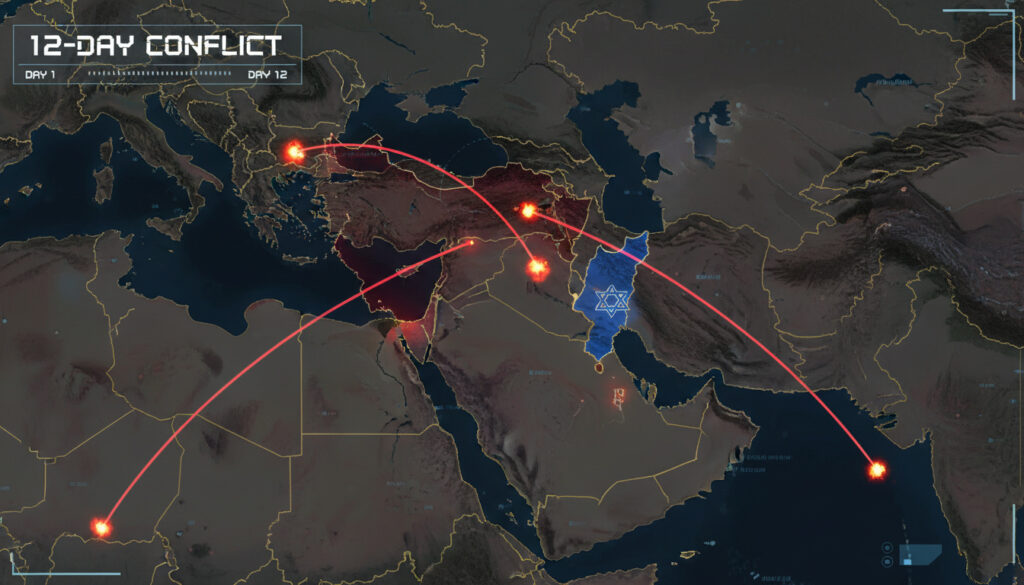
Iran Israel War – 12-Day Conflict Status and Timeline
The Iran-Israel conflict has transitioned from decades of shadow warfare to unprecedented direct military exchanges. As of June 25, 2025, a fragile ceasefire holds following twelve days of intense strikes involving nuclear facilities, ballistic missiles, and direct U.S. military intervention.
The confrontation, which peaked during what analysts term the “12-Day War” from June 13-24, 2025, resulted in over 900 deaths in Iran and significant damage to its nuclear infrastructure, while Israel sustained comparatively minor casualties and infrastructure damage.
This analysis examines the current military status, chronological developments, underlying causes, and the international response to determine whether the region faces sustained conflict or lasting de-escalation.
Is There a War Between Iran and Israel?
Current Status
Ceasefire effective June 24, 2025; no formal war declared between states
Key Trigger
April 1, 2024 Israeli strike on Iranian consulate in Damascus
Main Players
Iran’s Islamic Revolutionary Guard Corps (IRGC), Israel Defense Forces (IDF), U.S. military
Human Cost
900+ Iranian civilian and military deaths; minimal Israeli casualties
Key Insights:
- No formal declaration of war exists between Iran and Israel despite direct military exchanges
- The “12-Day War” in June 2025 marked the first sustained direct confrontation between the states
- Israel launched preemptive strikes on Iranian nuclear facilities on June 13, 2025
- U.S. forces conducted direct strikes against Iranian nuclear sites on June 22, 2025
- Iran agreed to a conditional ceasefire on June 24, halting attacks contingent on Israeli reciprocity
- The conflict has delayed Iran’s nuclear weapons program by an estimated two to three years
- Proxy forces including Hezbollah participated in initial 2024 escalation phases
| Aspect | Details |
|---|---|
| Formal War Status | No declaration; limited direct conflict |
| 12-Day War Duration | June 13-24, 2025 |
| Primary Aggressor | Israel (preemptive strikes) |
| U.S. Entry Date | June 22, 2025 |
| Ceasefire Agreement | June 24, 2025 (12-hour initial term) |
| Iranian Casualties | 900+ (civilians, military officials, scientists) |
| Israeli Casualties | Minimal; 1 child critically injured (2024) |
| Nuclear Facilities Damaged | Fordow, Natanz, Esfahan, Arak |
| Key Trigger Event | April 1, 2024 Damascus consulate strike |
| IRGC Commander Killed | Major General Ali Shadmani (June 18) |
What Are the Latest Developments in the Iran-Israel Conflict?
The conflict entered its most visible phase on June 13, 2025, when Israeli Prime Minister Benjamin Netanyahu informed then-President Donald Trump before authorizing extensive airstrikes against Fordow, Natanz, Esfahan, and Arak nuclear facilities. The attacks targeted fortified underground sites and military installations, killing over 70 individuals at Evin Prison and numerous nuclear scientists. Iran responded with missile barrages targeting Tel Aviv intelligence headquarters and the Haifa oil refinery.
Following Israeli requests for assistance against hardened targets, Trump authorized U.S. strikes on June 22, 2025, hitting three nuclear sites that Israeli capabilities could not destroy independently. The U.S. role drew explicit warnings from Supreme Leader Ayatollah Ali Khamenei, who threatened “irreparable harm” should America intervene directly.
Financial markets experienced volatility during the crisis, drawing attention to major corporate delistings and Twitter Share Price – Delisted Status and History as investors sought comparative contexts for geopolitical risk assessment.
The 12-Day War Ceasefire
As of June 24, Iranian President Masoud Pezeshkian agreed to halt attacks conditionally, requiring Israeli reciprocity. The initial 12-hour truce extended indefinitely after both sides ceased offensive operations. Israel subsequently canceled planned final assaults while Iranian parliamentarians considered suspending cooperation with international nuclear monitors.
The June 24 agreement remains technically effective, with Iran halting missile barrages contingent upon Israeli cessation. President Trump claimed U.S.-Israeli forces had “obliterated” nuclear sites, though independent verification of complete destruction remains unavailable.
Why Is Iran Attacking Israel?
Iran’s direct military actions represent a departure from decades of proxy warfare, driven by specific triggering events and strategic calculations.
The Damascus Consulate Strike
The April 1, 2024 Israeli bombing of the Iranian consulate in Damascus, Syria, killed multiple senior Iranian officials and served as the immediate catalyst for Iran’s first claimed direct military response. Euro News reports that this strike shattered the previous pattern of deniable confrontations.
Retaliation for Assassinations
Iran cited the July 31, 2024 killings of Hamas leader Ismail Haniyeh in Tehran and Hezbollah commander Fuad Shukr in Beirut as additional justification for its October 1 missile barrage comprising approximately 200 ballistic missiles.
Regional Proxy Dynamics
For decades, both nations engaged in proxy warfare through affiliated militias. The 2024-2025 escalation reflects Iran’s transition from asymmetric tactics through Hezbollah and Houthi forces to direct state-on-state confrontation, fundamentally altering the conflict’s risk profile.
Will This Escalate to Full-Scale War or WW3?
Despite global concerns regarding broader conflagration, available evidence suggests containment rather than unlimited escalation.
WW3 Risk Assessment
The conflict remained geographically contained to Israeli and Iranian territory. No allied nations beyond the United States engaged militarily, and the confrontation concluded within twelve days without triggering broader regional warfare. Analysts note that while Iran issued threats regarding Iraq-based proxy launches, these did not materialize following the 2024 exchanges.
While the June 25 ceasefire holds, tensions persist. Iranian parliamentary consideration of IAEA suspension and Israel’s cancellation of final assaults suggest mutual deterrence, but the absence of diplomatic normalization leaves the region vulnerable to rapid re-escalation should either side perceive advantage in renewed hostilities.
Current De-escalation Status
Sources describe containment via quick ceasefire mediation; no global involvement beyond U.S. strikes and prior intercepts. Trump’s announcement of the ceasefire on June 24 proved critical in preventing further expansion.
Hezbollah, which coordinated rocket fire with Iran in April 2024, did not feature prominently in the June 2025 exchanges. However, the group’s capabilities and allegiances remain critical variables for future stability assessments, particularly given the assassination of commander Fuad Shukr.
What Is the Detailed Timeline of Events?
- : Israeli airstrike destroys Iranian consulate in Damascus, killing senior officials. Source
- : Iran and allies launch approximately 300 drones and missiles at Israel; U.S., UK, and Jordan intercept most. Minor damage to Nevatim Airbase; one child critically injured. Source
- : Israel strikes near Isfahan Airport, damaging Natanz radar and air defense systems. Source
- : Assassinations of Hamas leader Ismail Haniyeh in Tehran and Hezbollah’s Fuad Shukr in Lebanon. Source
- : Iran fires approximately 200 ballistic missiles at Israel, citing the assassinations. Source
- : Israel conducts strikes near Tehran airports, Mashhad, and locations in Syria. Source
- : Israel initiates “12-Day War” with preemptive nuclear facility strikes; Netanyahu informs Trump beforehand. Source
- : Israel hits IRIB TV headquarters, killing anchor Sahar Emami; Iran damages Haifa oil refinery. Source
- : Israel kills IRGC Major General Ali Shadmani; Khamenei warns U.S. against intervention. Source
- : U.S. attacks three fortified Iranian nuclear sites. Source
- : Ceasefire declared following final Iranian missile barrage; both sides halt offensive operations. Source
What Facts Are Established and What Remains Uncertain?
| Established Information | Information That Remains Unclear |
|---|---|
| Direct military exchanges occurred between June 13-24, 2025 | Long-term viability of the June 24 ceasefire agreement |
| Over 900 Iranians killed, including civilians, military officials, and nuclear scientists | Full extent of damage to underground nuclear facilities at Fordow and Natanz |
| U.S. forces conducted direct strikes on June 22, 2025 | Whether Iran will formally suspend IAEA cooperation |
| Iran’s nuclear program delayed an estimated 2-3 years | Potential for Hezbollah re-engagement in future phases |
| Israel sustained minimal civilian casualties; Haifa refinery damaged | Actual operational status of Iran’s remaining missile stockpiles |
| Ceasefire holds as of June 25, 2025, with conditional Iranian compliance | Timeline for potential resumption of diplomatic negotiations |
What Is the Historical Context?
The Iran-Israel relationship evolved from tacit cooperation during the pre-revolutionary era to intense adversarial status following the 1979 Islamic Revolution. For four decades, hostility manifested through proxy militias, covert operations, and nuclear threats rather than direct state warfare.
The 2024-2025 escalation marks a paradigm shift. While previous confrontations—including strikes on Iranian nuclear scientists and Israeli targets abroad—remained deniable or limited, the April 2024 Damascus consulate bombing prompted Iran’s first claimed direct military response. This established precedence for overt state-on-state attacks that culminated in the June 2025 “12-Day War.”
The nuclear dimension remains central to the conflict. Iranian enrichment activities and Israel’s stated red lines regarding weapons capability created the conditions for preemptive strikes. The International Atomic Energy Agency monitors Iranian compliance, though parliamentarians currently consider suspension of cooperation following the facility strikes.
Official Statements and Sources
Iran agreed to stop attacks if Israel reciprocated, and the ceasefire initially set for 12 hours has held.
— Tehran Times, June 24, 2025
The United States attacked three nuclear sites on June 22, targeting fortified locations Israeli capabilities could not destroy independently.
— Xinhua News Agency, June 25, 2025
If the U.S. enters the war directly, irreparable harm will be done to the United States.
— Ayatollah Ali Khamenei, as reported by Tehran Times, June 18, 2025
Current Status and What Comes Next
As of June 25, 2025, the Iran-Israel conflict exists in a state of suspended hostility. The ceasefire declared on June 24 remains technically effective, with both sides having ceased offensive missile and air operations. Iran has signaled conditional acceptance of peace terms while evaluating IAEA suspension. Israel has abandoned planned final strikes. The conflict caused over 900 Iranian deaths and significant nuclear infrastructure damage, yet stopped short of invasion or regime change. While Marks and Spencer Australia – Where to Shop in 2025 and other international businesses monitor regional stability, the immediate threat of WW3 has receded, though the fundamental territorial and nuclear disputes remain unresolved.
Frequently Asked Questions
Has Israel declared war on Iran?
No formal war declaration has been issued by either state. The conflicts are referred to as direct military exchanges or the “12-Day War” but lack formal declaration status.
What is the current status of Iran Israel tensions?
A ceasefire effective June 24, 2025, has halted direct strikes. Iran agreed to stop attacks conditionally while tensions persist without active warfare.
How many casualties occurred in the Iran Israel war?
Over 900 Iranians including civilians, military officials, and scientists died. Israeli casualties remained minimal with infrastructure damage but few deaths.
Did Hezbollah participate in the 2025 conflict?
No. Hezbollah coordinated attacks in April 2024 but did not feature in the June 2025 exchanges.
What role did the U.S. play in June 2025?
The U.S. conducted direct strikes on three Iranian nuclear sites on June 22 and mediated the ceasefire.
Are the nuclear facilities completely destroyed?
No. Damage has delayed the program 2-3 years, but independent verification of full destruction remains unavailable.
Is the war completely over?
The 12-Day War ended with a ceasefire, but underlying tensions and conditional compliance suggest fragility.
What triggered Iran’s attacks in 2024?
The April 1 Israeli strike on the Damascus consulate and subsequent assassinations of Haniyeh and Shukr.
Was World War Three imminent?
Analysts assessed WW3 risk as low due to quick containment and limited international participation beyond U.S. involvement.
What happens next?
Uncertainty remains. Iran considers IAEA suspension while Israel maintains defensive positions. No active negotiations are confirmed.
More related posts
 Cruise Ship FAQ: Wife On Board, Charlie Charlie, Disembarkation
 Seth MacFarlane: Bio, Net Worth, 9/11 Rumor, and Personal Life
 Aisha Dee: Ethnicity, LGBTQ Identity, and Biography
 Brandi Glanville’s Facial Disfigurement: Biopsy & Timeline
 Mike White: Net Worth, White Lotus, Survivor & Personal Life
 16 USD to AUD – Live Rate, Trends & Conversion Guide
 Rafe Cameron Guide: Actor, Mental Health & Arc
 Daniel MacPherson: Age, Height, Wife, Children, Movies & TV Shows