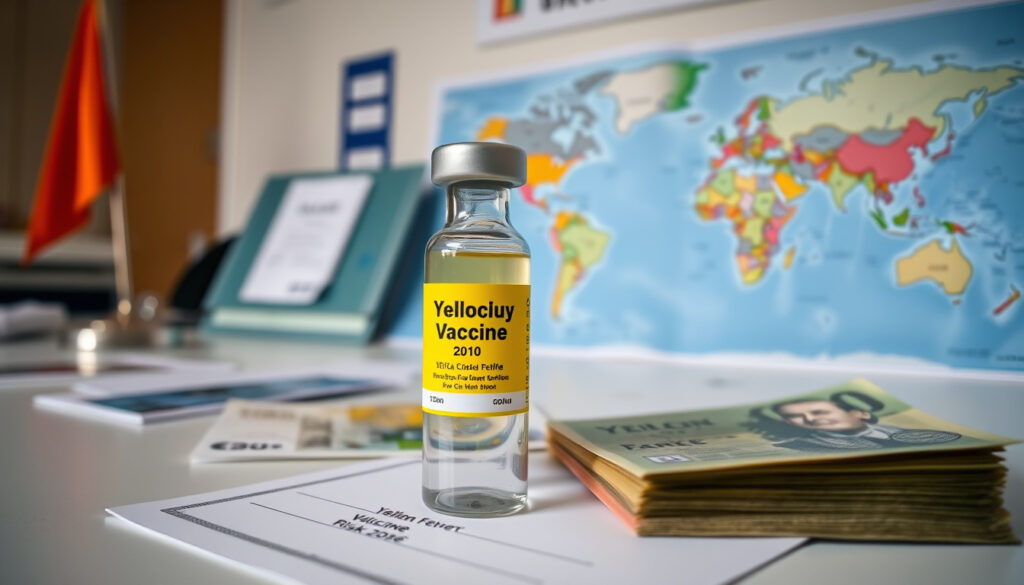
Yellow Fever Vaccine: Ireland Guide, Requirements & Cost
If you’re heading somewhere tropical for work or holiday, there’s a good chance you’ll need proof of yellow fever vaccination before you’re allowed through border control. Unlike some travel vaccines you can arrange at your GP, the yellow fever jab requires a visit to an approved centre—and in Ireland, that means knowing where to book and what it’ll cost. Here’s what you need to know before you pack.
Protection onset: 1 week in 95% of people · Standard duration: 10 years · Minimum age: 9 months · Cost in Ireland: €40–€75 · Vaccine type: Live attenuated
Quick snapshot
The table below summarises the key facts Irish travellers need before booking a yellow fever vaccination.
- Specialist travel clinics only (Masta Ireland)
- Dublin, Cork, and regional clinic locations (TMB)
- €40–€75 vaccine dose (TMB)
- €10–€20 yellow card (Travel Health Clinic)
The table below outlines the core specifications and provider details for the yellow fever vaccine in Ireland.
| Vaccine detail | Value |
|---|---|
| Vaccine name | YF-Vax or Stamaril |
| Efficacy | Nearly 100% |
| Booster needed? | Every 10 years |
| Irish providers | TMB.ie, NHS.uk referrals |
Which countries require the yellow fever vaccine?
More than 30 countries—mostly in sub-Saharan Africa and parts of South America—require incoming travellers to show an International Certificate of Vaccination or Prophylaxis (ICVP) against yellow fever. The rule applies whether you’re passing through from an endemic zone or arriving directly from a non-endemic country.
Risk areas in Africa and South America
The Centers for Disease Control and Prevention (CDC) maintains updated maps showing where yellow fever transmission risk is highest. Endemic zones span West Africa (including Ghana, Nigeria, and Senegal) and the Amazon basin in South America (Brazil, Peru, Bolivia). Travellers heading to these regions for work, family visits, or safari holidays are typically the ones who need the certificate most urgently.
Entry requirement rules
Some countries blanket-require the vaccine for all visitors. Others only ask for proof if you’re arriving from a yellow fever risk zone—the list changes based on your transit points, so it pays to check the requirements for every country on your route. The NHS fitfortravel destination database lets you search by destination and see exactly what’s needed before you depart.
The catch: without a valid certificate, border officials can refuse entry or quarantine you at your own expense. There’s no work-around once you’re at the airport—plan well before your travel date.
How to get yellow fever vaccine in Ireland?
Unlike routine NHS vaccines you might arrange through a GP, yellow fever vaccination in Ireland must be administered at a registered Yellow Fever Vaccination Centre. These are specialist travel clinics that have met strict cold-chain and documentation standards.
Approved clinics and centres
Ireland has a network of approved centres spread across the main cities and some regional towns. Tropical Medical Bureau (TMB) operates clinics in Dublin, Cork, and Galway. BHI Travel Health in Cork, Cashel Medical Centre in Tipperary, and several smaller centres round out the options.
Booking process
Most clinics allow online booking or require a phone call to arrange an appointment. Because the vaccine requires a pre-assessment—assessing your medical history, current medications, and travel plans—walk-in availability is limited. Plan to book at least 2–3 weeks before you intend to travel to secure a slot.
Can my GP give me yellow fever vaccine?
In most cases, no. Standard GP practices in Ireland are generally not registered Yellow Fever Vaccination Centres. Masta Ireland notes that the vaccine is only available from registered centres due to the rare risk of serious reactions that require immediate clinical management. Your best bet is to use the National Travel Health Centre or a dedicated travel clinic.
Regular GPs lack the authority to issue the International Certificate—only approved Yellow Fever Vaccination Centres can do that. Book at a registered centre from the start to avoid needing a second appointment elsewhere.
The implication: travellers who book a standard GP appointment first often end up paying for two consultations before they can get the certificate they need.
How many years is a yellow fever shot good for?
The standard rule, backed by the NHS, is that a single dose protects you for 10 years. Most countries accept a certificate issued at any point in that window—no booster is required for shorter trips.
Standard validity period
The yellow fever vaccine (marketed as YF-Vax or Stamaril) generates immunity within 10 days for 99% of recipients. According to Masta Ireland, for most adults who receive the jab after their first birthday, the protection is considered lifelong. However, many countries still recognise the 10-year certificate period rather than requiring proof of lifelong immunity, so check the specific entry rules for your destination.
Does a yellow card expire?
The International Certificate of Vaccination or Prophylaxis becomes valid 10 days after your vaccination and remains current for 10 years. After that, a booster dose reactivates the certificate. If you’re not sure whether your certificate is still valid, contact your travel clinic—they can often check their records and advise whether a booster is warranted.
If you were vaccinated as a child or years ago and are heading back to an endemic area, you may not need a new dose—but you will need proof that the certificate is within its validity window. Check before you travel rather than assuming.
The pattern: YF-Vax and Stamaril dominate the Irish market, with near-universal efficacy reported across both formulations.
Who should avoid the yellow fever vaccine?
The yellow fever vaccine is a live attenuated vaccine, which means it contains a weakened form of the virus. For most healthy adults this poses no problem, but certain groups face genuine risk and should discuss alternatives with a clinician before booking.
Contraindications and risks
According to CDC guidance, the following groups should generally avoid the standard yellow fever vaccine:
- Infants under 9 months of age (the minimum age threshold)
- Immunocompromised individuals, including those on chemotherapy or high-dose immunosuppressants
- Pregnant women, unless absolutely necessary
- People with severe egg protein allergy (the vaccine is egg-based)
- Those with thymus disorders or a history of thymus removal
Alternatives for at-risk groups
If you’re in one of these groups, a travel health specialist can advise on whether a medical exemption letter is appropriate or whether delayed travel might be the safer choice. Some countries accept a letter from your GP explaining why vaccination was contraindicated—but the rules vary, so get documentation in advance.
A small number of vaccine recipients (roughly 1 in 100,000–300,000) experience severe adverse events including anaphylaxis or viscerotropic disease. This risk is why assessment by a qualified travel health nurse before vaccination is non-negotiable.
The implication: the pre-assessment exists because the rare serious risks are real. Skipping it to save time is not worth the potential consequences.
How much does the yellow fever vaccine cost in Ireland?
Prices vary noticeably across Irish clinics—from €40 to €75 for the vaccine dose alone—before you factor in the consultation fee. Here’s what the main providers charge.
Clinic pricing examples
Five registered clinics provided pricing on their websites at time of research. Dr Ciaran Bent lists the vaccine at €40 plus a €65 consultation fee per individual. BHI Travel Health Cork offers it at €40 with a €50 consultation fee. TMB charges €65 for the vaccine, with consultation fees of €70 for individuals or €50 each for group bookings.
At the higher end, Trinity Clinic lists the yellow fever vaccine at €75. Travel Health Clinic does not list a specific vaccine price but charges €80 for individual consultations.
Yellow card costs
The certificate itself—the physical ICVP card—is usually issued as part of your appointment. Clinics typically charge €10–€20 for the card and documentation. Check whether this is included in the consultation fee when you book.
What are yellow fever vaccine side effects?
Most people experience only mild side effects: soreness at the injection site, a low-grade fever, or mild headache for a day or two. According to NHS guidance, serious reactions are rare but can include the severe adverse events noted above. The pre-vaccination assessment is designed to catch anyone at elevated risk before they receive the dose.
A €40–€75 vaccine plus a consultation fee is a real cost—but compare it to the expense of being turned away at a border, forced into quarantine, or worse. For travellers to endemic zones, the investment is usually worth making.
The implication: for most Irish travellers, one clinic visit covers both the jab and the certificate—but costs vary enough to warrant checking at least two providers before booking.
Upsides
- Nearly 100% effective with a single dose
- One certificate covers 10 years of travel
- Widely available at Irish travel clinics
- Live attenuated vaccine means lifelong immunity for most adults
- Required for entry to 30+ countries, protecting your trip investment
Downsides
- Cost between €40–€75 plus consultation, with no GP option
- Limited to approved Yellow Fever Vaccination Centres
- Not suitable for immunocompromised individuals or infants under 9 months
- Rare but serious adverse event risk (approx. 1 in 100,000–300,000)
- Requires pre-assessment appointment—can’t just walk in
The implication: weighing these factors, most healthy adults travelling to endemic regions will find the benefits of vaccination clearly outweigh the costs and limitations.
How to get your yellow fever certificate
Getting the ICVP certificate is straightforward once you know the steps. Here’s the process most Irish travellers follow.
- Check destination requirements — Use NHS fitfortravel or the CDC travel health website to confirm whether your destination requires the vaccine.
- Book at a registered centre — Contact an approved Yellow Fever Vaccination Centre (TMB, Dr Ciaran Bent, BHI Travel Health Cork, etc.) at least 2–3 weeks before travel.
- Attend pre-assessment — The nurse or doctor will review your medical history, current medications, and travel plans before administering the vaccine.
- Receive your ICVP — If cleared, you’ll receive the yellow card on the same day. It becomes valid 10 days after vaccination and lasts 10 years.
- Keep it safe — Take the original certificate with you on your trip, not a photocopy. Border officials rarely accept copies.
Confirmed facts
- 10-year validity per CDC and NHS guidance
- Costs ranging from €40 to €75 for the vaccine dose across Irish clinics
- Consultation fees typically add €50–€80 per individual
What’s unclear
- Exact nationwide availability at individual GP practices (most are not registered centres)
- Whether all clinics accept walk-in re-checks for existing certificate validity
A single dose of yellow fever vaccine provides lifelong protection for most healthy adults, according to NHS guidance on travel vaccinations.
— NHS
Vaccination should be considered for all travellers going to endemic areas, with few exceptions. The International Certificate becomes valid 10 days after administration and is good for 10 years under current WHO guidelines.
— Centers for Disease Control and Prevention
TMB clinics provide yellow fever vaccination at €65 per dose, with individual consultation fees of €70. Appointments include a pre-vaccination health assessment to identify any contraindications.
— Tropical Medical Bureau
For Irish travellers heading to countries where yellow fever is endemic, the practical path is clear: book a registered travel clinic at least three weeks ahead, understand whether your destination requires the certificate, and factor the total cost—vaccine plus consultation plus card fee—into your travel budget. The 10-year validity window means one well-timed appointment can cover multiple trips, making it one of the more cost-effective travel health decisions you can make. Skip the jab, though, and you risk being turned away at the border—or worse, finding yourself unvaccinated in a high-risk area.
Related reading: Paw Paw Ointment: Uses, Benefits, Safety & Ingredients · How to Get Rid of Hiccups Fast with Proven Remedies
Frequently asked questions
What is the yellow fever vaccine name?
The two licensed yellow fever vaccines used in Ireland are YF-Vax and Stamaril. Both are live attenuated vaccines and provide the same protection level.
Where to find yellow fever vaccine near me in Ireland?
Approved centres include Tropical Medical Bureau (Dublin, Cork, Galway), Dr Ciaran Bent (Dublin), BHI Travel Health (Cork), Cashel Medical Centre (Tipperary), and Trinity Clinic (Dublin). Use the clinic finder on TMB.ie to locate your nearest option.
Is yellow fever vaccine safe?
For most healthy adults, the yellow fever vaccine is considered safe. Side effects are usually mild (sore arm, low fever). Serious adverse events are rare—roughly 1 in 100,000 to 300,000 recipients. The pre-assessment appointment screens out individuals at higher risk.
How do you get a yellow fever vaccine certificate?
Book an appointment at a registered Yellow Fever Vaccination Centre, attend the pre-assessment, and receive the vaccine if cleared. The clinic issues the International Certificate of Vaccination or Prophylaxis (ICVP) on the same day.
Is yellow fever vaccine available at Boots in Ireland?
Boots pharmacies in Ireland do not typically offer yellow fever vaccination. The vaccine is restricted to registered Yellow Fever Vaccination Centres due to its storage and documentation requirements.
Can I get yellow fever vaccine at Dublin airport?
No. Yellow fever vaccine is not available at Dublin Airport. You must visit a registered travel clinic before departure. The vaccine takes 10 days to become valid, so airport-arranged vaccination on the day of travel would not help your entry requirements.
Does a yellow fever vaccine expire?
The International Certificate of Vaccination is valid for 10 years from the date of vaccination. Most adults develop lifelong immunity after a single dose, but the official certificate period is 10 years.
More related posts
 Pete Davidson: Illness, Relationships, Net Worth and More
 Cats Human Years: How to Convert Cat Age to Human Years
 Craig McRae Wife – Gabrielle McRae and Family Facts
 Aud to USD Exchange Rate – Live Rates, Charts and Analysis
 Tyrese Gibson Divorce: Wife Left, Net Worth, My Shayla Meme
 Homemade Strawberry Shortcake: Biscuit vs Cake Method
 Channel 9 Presenter Departures: Who Left in 2025
 Edward VII: The Peacemaker King