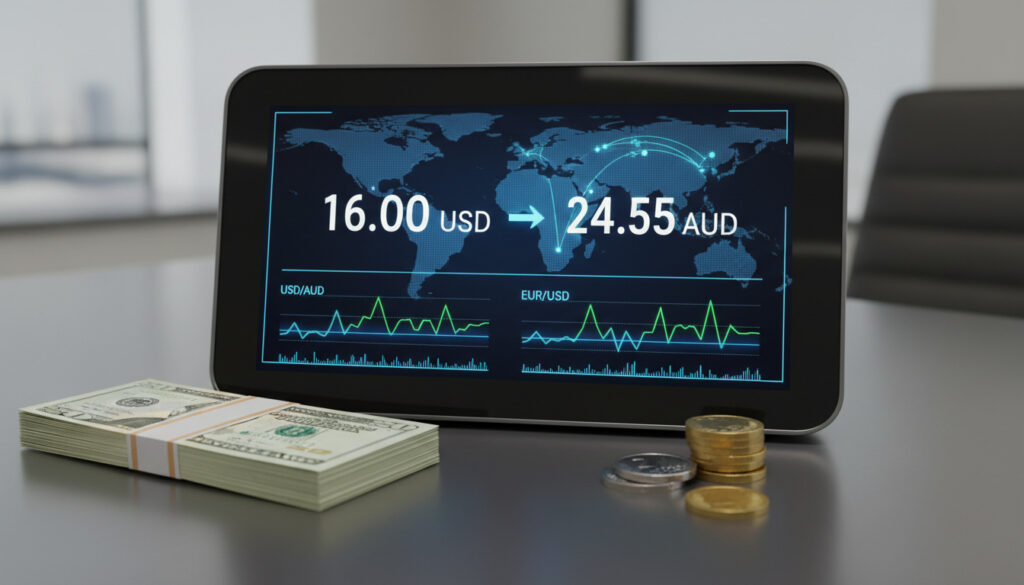
16 USD to AUD – Live Rate, Trends & Conversion Guide
Converting 16 United States dollars to Australian dollars yields approximately 25.73 AUD at the current mid-market exchange rate. The precise amount fluctuates continuously throughout global trading sessions as currency markets respond to central bank policy shifts and economic data releases.
The USD to AUD pair reflects the relative economic strength of the world’s largest economy against a commodity-sensitive Asia-Pacific currency. While the mid-market rate stands near 1.60785 Australian dollars per US dollar, actual conversion amounts depend on the specific provider and timing of the transaction.
Travelers and remittance senders should note that retail banks and airport kiosks rarely offer the mid-market figure, instead applying margins that can reduce the final Australian dollar amount by several percentage points.
What is 16 USD to AUD Today?
1.60785 AUD per USD
~25.73 AUD
+1.22% average
3–6% bank markup
- 16 USD converts to roughly 25.73 AUD at the interbank rate, while retail banks typically quote closer to 24.58 AUD after fees.
- The pair reached a 30-day high of 1.6794 and a low of 1.5670, demonstrating significant daily volatility.
- Rate discrepancies exist between providers: Wise lists 1.60785, while Revolut shows approximately 1.536 for the same amount.
- Recent 90-day data indicates an average of 1.5968, representing a 1.17% decline over the quarter.
- The Australian dollar’s valuation maintains a strong correlation with iron ore export prices and Reserve Bank of Australia policy signals.
- February 2026 data from the Federal Reserve Economic Database indicates an inverse rate of 0.7060 USD per AUD.
| Metric | Value | Source |
|---|---|---|
| 16 USD in AUD (Mid-Market) | ~25.73 AUD | Wise |
| 16 USD in AUD (Revolut) | ~24.58 AUD | Revolut |
| 30-Day High | 1.6794 AUD per USD | Wise |
| 30-Day Low | 1.5670 AUD per USD | Wise |
| 90-Day Average | 1.5968 | Wise |
| Reverse Rate (16 AUD to USD) | ~9.95 USD | Wise |
How to Convert 16 USD to AUD?
Using Digital Conversion Platforms
Mid-market services like Wise and Revolut provide rates closer to the interbank figure than traditional financial institutions. These platforms typically display the real-time rate before confirming the transaction, allowing users to lock in conversions when 16 USD yields favorable AUD amounts.
Avoiding Common Fee Traps
Airport kiosks and hotel exchange desks routinely apply spreads of 5–10% above the mid-market rate. For small amounts like 16 USD, fixed fees can further erode the final Australian dollar total, making digital transfers or ATM withdrawals abroad more economical alternatives.
Traditional banks typically add 3–6% to the mid-market rate when converting USD to AUD. For 16 USD, this markup could cost you approximately 0.50–1.50 AUD compared to digital transfer services.
What Factors Affect the USD to AUD Exchange Rate?
Reserve Bank of Australia and Federal Reserve Policies
The Reserve Bank of Australia’s cash rate decisions directly influence AUD strength, with higher rates typically attracting capital inflows. Conversely, Federal Reserve rate hikes strengthen the USD against the Australian dollar, as evidenced by recent policy divergence where RBA easing signals coincided with Fed tightening.
Commodity Export Cycles
Australia’s economic fortunes remain tied to iron ore and energy exports. When commodity prices decline, the AUD weakens against the USD, increasing the Australian dollar cost of imports while simultaneously improving the USD purchasing power for Australian goods.
Global Risk Sentiment
During periods of geopolitical uncertainty, investors seek safe-haven assets, typically strengthening the USD at the expense of the AUD. This flight-to-quality dynamic can shift the 16 USD to AUD conversion rate by several percentage points within single trading sessions.
Currency markets typically see reduced volatility mid-week when trading volumes stabilize. Converting 16 USD to AUD between Tuesday and Thursday often yields more predictable rates than Monday or Friday sessions.
USD to AUD Historical Rates and Trends
Historical data from OFX reveals a steady decline in the USD/AUD rate from October 2025 through February 2026. Monthly averages dropped from 1.529 in October to 1.417 by February, before recovering to current levels near 1.60785.
Long-term charts from Xe and Wise demonstrate sustained volatility, with the pair oscillating between peaks near 1.68 and troughs around 1.41 over recent months. This 18-cent range significantly impacts the final amount received when converting modest sums like 16 USD.
The USD/AUD pair has shown significant volatility, swinging between 1.41 and 1.68 within recent months. Historical charts demonstrate this range over 5 to 20-year periods, emphasizing the importance of timing for small-sum conversions.
How Has the USD to AUD Rate Changed Over Time?
- : Monthly average 1.529 OFX
- : Monthly average 1.537 OFX
- : Monthly average 1.504 OFX
- : Monthly average 1.476 OFX
- : FRED reports 0.7060 USD per AUD (inverse ~1.416) FRED
- : Daily rates around 1.407–1.430 MTFX
What We Know and What Remains Uncertain
| Established Information | Information That Remains Uncertain |
|---|---|
| 16 USD = ~25.73 AUD at mid-market rates as of current data | The exact rate 24 hours from now |
| 30-day trading range: 1.5670–1.6794 | Whether the RBA will adjust cash rates in the next meeting |
| Banks charge 3–6% markup above mid-market | Future iron ore price movements affecting AUD fundamentals |
| Downward trend from Oct 2025 to Feb 2026 | Long-term equilibrium level between the currencies |
Why the USD to AUD Rate Matters
The exchange rate determines purchasing power for American tourists visiting Australia and for Australian importers sourcing US goods. A stronger AUD makes Australian exports more expensive in American markets while reducing the cost of US technology and services for Australian consumers.
For context on how other currency pairs behave in the Asia-Pacific region, see the AUD to CLP – Live Rates, Chart & Conversion Guide.
Data Sources and Methodology
Exchange rate data derives from mid-market aggregators and central bank statistics. The Federal Reserve Economic Database provides official inverse rates, while commercial platforms offer real-time retail comparisons.
Recent weakening of the AUD ties to lower commodity prices and RBA easing signals versus Fed tightening.
— Federal Reserve Economic Data, February 2026
Key Takeaways for 16 USD to AUD
Converting 16 USD to AUD yields approximately 25.73 Australian dollars at mid-market rates, though bank customers may receive closer to 24.50 AUD after fees. The rate fluctuates within a 1.56–1.68 range based on central bank policies and commodity prices. For optimal value, use mid-week transfers via digital platforms rather than airport kiosks. While currency markets differ from equity markets, both react sharply to policy shifts, as demonstrated in the Twitter Share Price – Delisted Status and History.
Common Questions
How much is 16 AUD in USD?
The reverse conversion yields approximately 9.95 USD at the mid-market rate of 0.622 USD per AUD. Revolut data suggests a slightly higher 10.24 USD figure depending on their specific spread.
Do exchange rates update in real time?
Yes, the USD to AUD rate fluctuates continuously during forex trading hours. Platforms like Wise and Revolut refresh their displayed rates every few seconds, though banks may update only once daily.
Why is there a difference between the mid-market rate and my bank’s rate?
Banks add a margin, typically 3–6%, to cover operational costs and profit. For 16 USD, this markup reduces your AUD amount by approximately 0.50–1.50 compared to mid-market services.
Should I convert USD to AUD now or wait?
Current trends show mild USD strength around 1.60–1.61. Without reliable short-term forecasts, setting rate alerts at your target level provides the most practical approach for small conversions.
Are there taxes on converting 16 USD to AUD?
Currency conversion itself typically incurs no direct tax, though gains from forex trading may trigger capital gains obligations. Consult local tax authorities for specific regulations regarding foreign exchange transactions.
How do I track the USD to AUD rate over time?
Use charting tools from Xe, Wise, or OFX to visualize 5 to 20-year historical data. Setting mobile alerts for specific rate thresholds helps capture favorable moments for converting small amounts.
More related posts
 Andrea Bocelli: Biography, Blindness, Songs, and Personal Life
 James Garner: Love of His Life, Health, and Relationships
 What’s On in Melbourne: Events, Festivals & Things to Do
 Mike Mentzer: Heavy Duty Training, Death & Arnold Feud
 Will.i.am Bio, Net Worth, Relationships, and Health Facts
 Denham Hitchcock: Age, Wife, Father, and Career | Biography
 Cats Human Years: How to Convert Cat Age to Human Years
 Shirley Henderson: Biography, Age, Career & Moaning Myrtle