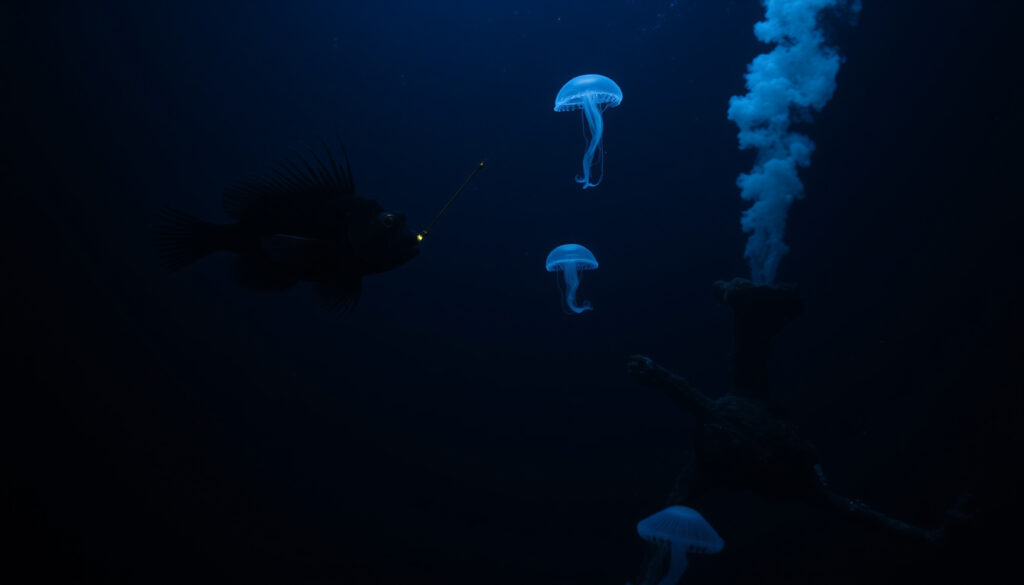
Deep Sea: Definition, Animals, and Exploration Facts
Few places on Earth stay as hidden as the deep sea — a world of endless night, bone-crushing pressure, and creatures that look like science fiction. This vast, cold realm covers about three-fourths of the ocean floor, yet we have mapped less of it than the surface of Mars.
Depth where sunlight reaches: 200 meters (660 feet) · Deepest point on Earth: Challenger Deep in the Mariana Trench at about 11,000 meters (36,000 feet) · Ocean area covered by deep sea: 75%
Quick snapshot
- The deep sea begins at 200 meters depth (Smithsonian Ocean (natural history museum))
- Challenger Deep is the deepest point at about 11,000 meters (Smithsonian Ocean)
- Box jellyfish venom is potent (NOAA Ocean Exploration (federal agency) – context: many deep-sea animals are venomous)
- Exact number of deep-sea species remains unknown (Woods Hole Oceanographic Institution (research institute))
- Which animal is the absolute smartest in the ocean (NOAA Ocean Exploration)
- The exact deadliest animal in the deep sea due to rare encounters (NOAA Ocean Exploration)
- After the loss of the submersible Nereus, a flurry of crewed dives began — including Victor Vescovo’s dives to the deepest points of all five major ocean basins (NOAA Ocean Exploration)
- WHOI’s Orpheus autonomous underwater vehicles (AUVs) can work in swarms to map and analyze the hadal zone at pressures over 1,000 atmospheres (Woods Hole Oceanographic Institution)
Over 1,100 atmospheres of pressure at the deepest point — that is the weight of 50 jumbo jets on every square inch. Only a handful of vehicles have ever survived it, and the next generation of AUVs promises to open the hadal zone to routine study.
The key facts below show the scale of the deep sea’s physical extremes.
| Attribute | Value |
|---|---|
| Depth of deep sea start | 200 meters (660 feet) |
| Deepest point | Challenger Deep, 11,000 meters (36,000 feet) |
| Pressure at deepest point | Over 1,100 atmospheres |
| Temperature | Near freezing (2–4°C) |
| Number of species | Tens of thousands, many undiscovered |
The deep sea remains one of the least explored habitats on Earth, with new species and features discovered on nearly every expedition.
What is a deep sea called?
Definition of the deep sea
The deep sea is the part of the ocean where sunlight does not penetrate — generally below 200 meters (660 feet). As the Smithsonian Ocean (museum and research center) notes, “About three-fourths of the area covered by ocean is deep, permanently dark, and cold.“
Scientists divide the deep ocean into vertical zones based on depth. The NOAA Ocean Exploration (U.S. federal agency) classifies five primary zones: epipelagic (0–200 m), mesopelagic (200–1,000 m), bathypelagic (1,000–4,000 m), abyssal (4,000–6,000 m, depending on the source), and hadal (6,000–11,000 m).
Depth classification zones
Different institutions publish slightly different depth ranges, which can cause confusion. The Woods Hole Oceanographic Institution (WHOI, leading ocean research institute) places the abyssal zone from 3,000 to 6,500 meters, while the Smithsonian describes the abyssopelagic zone from 4,000 to 6,000 meters. The hadal zone is consistently defined as 6,000 meters to the bottom of the deepest trenches — about 11,000 meters at the Mariana Trench (WHOI).
Six depths, one pattern: the boundary between abyssal and hadal sits near 6,000 meters, confirmed by a study of the Yap Trench published in Frontiers in Marine Science (Frontiers in Marine Science (peer-reviewed journal)), which found that megafaunal communities shift significantly at that depth. The Gerringer Lab (university research lab) also notes that hadal ecosystems are distinct from abyssal plains, with community-structure changes occurring around 6,000 meters.
Definitions vary by institution — but the 6,000-meter line is the most widely accepted ecological boundary between the abyssal and hadal zones.
The implication: researchers must specify which source they use when citing depth ranges.
What is the deadliest animal in the deep sea?
Candidates for the title
While the box jellyfish is often cited as the most venomous marine animal, human encounters in the deep sea are so rare that no single species can be crowned “deadliest.” The NOAA Ocean Exploration notes that hadal systems remain among the most poorly explored habitats on Earth, partly due to extreme pressure and distance from land.
- Box jellyfish venom can cause cardiac arrest in minutes, but it lives in shallow tropical waters, not the deep sea.
- Stonefish and cone snails are extremely venomous but are found on reefs, not in the abyssal or hadal zones.
- Many deep-sea animals — such as certain jellyfish and fish — produce venom, but their danger to humans is unknown because we rarely encounter them.
What is the deepest sea in the world?
The Mariana Trench
The deepest part of the ocean is the Mariana Trench in the western Pacific Ocean. Within it lies Challenger Deep, the single deepest point on Earth. According to the Smithsonian Ocean, the hadalpelagic zone extends from 6,000 meters to the bottom of the Mariana Trench at 10,994 meters. NOAA rounds this to about 11,000 meters (36,000 feet).
Other deep-sea trenches
Earth’s oceans host dozens of trenches deeper than 6,000 meters. The NOAA Ocean Exploration reports that hadal trenches and troughs cover an area about half the size of Australia, and new regions of hadal seafloor are still being discovered. The Five Deeps project, led by Victor Vescovo, identified the deepest point in each of the five major ocean basins.
What this means: the Mariana Trench holds the record, but dozens of other deep-sea trenches remain poorly mapped.
What is the #1 smartest animal in the ocean?
Dolphins
Dolphins are widely regarded as the most intelligent marine animals due to their complex social structures, communication, and problem-solving abilities. However, determining a single “smartest” is subjective, and much of the deep sea remains unstudied. The NOAA Ocean Exploration emphasizes that our knowledge of deep-sea animal behavior is extremely limited.
Octopuses and whales
Octopuses display remarkable intelligence, including tool use and camouflage abilities. Whales, especially toothed whales like orcas, exhibit sophisticated hunting strategies and cultural learning. But no definitive ranking exists. The Woods Hole Oceanographic Institution notes that the abyssal zone is largely unexplored and contains animals found nowhere else — their cognitive abilities are a mystery.
What’s another word for deep sea?
Synonyms and scientific terms
The deep sea is also referred to as the abyssal zone (typically 3,000–6,500 m) or hadal zone (6,000–11,000 m). The terms “deep ocean” and “abyss” are common synonyms. The Woods Hole Oceanographic Institution uses “abyssal” for the vast plain between 3,000 and 6,500 m, while “hadal” refers exclusively to trenches. A Frontiers in Marine Science study confirms that the boundary between the two zones lies at approximately 6,000 meters.
Five key zones, one pattern: each layer has its own light, pressure, and temperature regime that shapes the life found there.
| Zone | Depth range (approximate) | Characteristics |
|---|---|---|
| Epipelagic (sunlight) | 0–200 m | Sunlit, photosynthetic life |
| Mesopelagic (twilight) | 200–1,000 m | Dim light, bioluminescent animals |
| Bathypelagic (midnight) | 1,000–4,000 m | No light, high pressure |
| Abyssal | 3,000–6,500 m (varies) | Cold, high pressure, unique fauna |
| Hadal | 6,000–11,000 m | Deepest trenches, extreme pressure, poorly explored |
Sources: NOAA Ocean Exploration, WHOI Abyssal Zone, WHOI Hadal Zone, Smithsonian Ocean
“About three-fourths of the area covered by ocean is deep, permanently dark, and cold.”
— Smithsonian Ocean
“Hadal systems remain among the most poorly explored habitats on Earth because of extreme pressure and distance from land and the sea surface.”
— NOAA Ocean Exploration
The deep sea is Earth’s last unexplored frontier. For researchers, the choice is clear: invest in new AUV technology and risk the pressure, or leave 75% of the planet’s surface a blank map. With Orpheus swarms already on the horizon, the hadal zone may soon yield its secrets — or show us just how little we truly know.
pmc.ncbi.nlm.nih.gov, oceanexplorer.noaa.gov, youtube.com, whoi.edu, schmidtocean.org, oceantoday.noaa.gov
Frequently asked questions
How deep is the deep sea?
The deep sea is generally defined as starting at 200 meters (660 feet) below the surface, where sunlight no longer reaches.
What is the pressure in the deep sea?
At the deepest point (Challenger Deep), pressure exceeds 1,100 atmospheres — equivalent to the weight of about 50 jumbo jets per square inch.
What do deep sea creatures eat?
Most deep-sea animals rely on “marine snow” — organic particles that drift down from upper layers — or on chemosynthetic bacteria near hydrothermal vents.
How do deep sea animals survive without sunlight?
They have adaptations such as bioluminescence, slow metabolisms, and specialized pressure-resistant cells.
What is bioluminescence?
Bioluminescence is the production of light by living organisms through chemical reactions, used for communication, camouflage, and hunting.
Can humans visit the deep sea?
Yes, but only in specialized submersibles. Only a handful of people have ever visited the hadal zone.
What is the temperature of the deep sea?
Near freezing — typically between 2°C and 4°C (35–39°F).
Are there any plants in the deep sea?
No. Photosynthesis is impossible without sunlight. The deep sea depends entirely on organic material sinking from above.
More related posts
 Hailey Welch: Hawk Tuah Coin Crash, Net Worth, Where Now
 Lily Collins: Her father, health, and career facts
 Barbie Doll Value: Are They Worth Money? (2026 Guide)
 Melbourne Cup 2025 – Winner Results and Key Facts
 Martin Freeman: Relationships, Career, and Cumberbatch
 Clip-On Earrings: Best Brands, Comfort & Adjustment Guide
 Commercial Real E tate Melbourne: Inve ting Guide & Tip
 Australia Pension Age Change 2026: Facts & Rates Explained